The Camden County Environmental Center in Cherry Hill is continuing through Friday, Jan. 9 its Winter Environmental Day Camp for kids of various ages.
The programs range from one to one-and-a-half-hour sessions that began during winter break last month.
Participants were separated into two groups, SnowTop Tots for children from 5 years old and younger on Mondays and Winter Tracks for those age 6 to 12 on Tuesdays and Fridays. Each class has a maximum class size of 15 students.
Each age group was taught about various aspects of the environment and natural world, specifically topics related to winter, and both groups covered seasonal hibernation. The younger group dabbled in winter nature discovery and snowflakes, while the older kids covered winter survival, the science behind snow and winter birds.
Fern Nguyen is one of the center’s environmental educators. She runs the winter program, as well as other environmental day camps in spring and summer. The winter break program is the first of its kind.
“We’ve been trying to put more effort into engaging the community on environmental topics,” she explained. “So we thought it’d be great to have a winter break program, especially for the younger ages, to engage them early on.”
The students also got to do STEM activities, as well as outdoor projects.
“The kids are off break, so it’s perfect to come in and do some fun activities like hiking, creating snow or looking up at snowflakes or exploring winter animals and hibernation,” Nguyen noted.
She said the county’s board of commissioners came up with the idea to get youngsters in the area engaged with the natural world and the environmental mission of the county.
“We really try to emphasize hands-on engagement, fun things for the kids to do,” she said. “The kids seem to be very engaged or very happy to participate in our activities, so we’re trying to get them outside playing in what little snow we have and exploring.”
Participants also utilized outdoor natural resources to make items like pine needle soda or pine cone syrup, and they analyzed the beaks of birds to see how they might seek out food through the season.
“We were having a good response to our winter program …,” Nguyen said. “It’s something for kids to report to while looking for something to do during their time off from school.”
The Camden County Library System has a new reciprocal borrowing agreement with its counterparts in Burlington, Gloucester and Atlantic counties.
Effective this month, the agreement invites Camden County cardholders in good standing to conveniently obtain a card in the neighboring counties and access a wider selection of materials.
“Libraries are the heart of our communities, and this partnership helps to strengthen libraries throughout our area,” said Commissioner Jennifer Fleisher, liaison to the Camden County Library System. “We’re excited to offer this program to our residents, giving them access to thousands more books and resources at no additional cost.”
The agreement is much like the reciprocal borrowing pilot program launched in 2024 that included Camden and Burlington counties, along with several counties in North Jersey. Because each library’s policies differ, access to certain services like eBooks, digital streaming services, museum passes, technology items and other online resources may be restricted.
“Partnering with our neighboring counties was the clear next step in expanding access to library resources,” explained Linda Devlin, director of the Camden County system. “We know that our community’s needs do not stop at the county line, so by sharing our resources, we are able to strengthen the need for equitable access to library services to all.”
Abigail Twiford/The Sun Joella Clamen presented a slide show at the library about the tavern’s role in the Revolutionary War, among its other history.
As part of its ongoing series to mark the upcoming 250th anniversary of America’s founding, the library hosted a Nov. 18 presentation on the Indian King Tavern.
The grant-funded project “U.S. at 250: South Jersey and the Revolution” is a year-long exploration of area history and its role in the nation’s beginning. The library talk focused on the tavern’s Revolutionary War history.
Joella Clamen, museum interpreter of the historic site, told stories and presented a slide show with historical photos, illustrations and maps to help explain the tavern’s past. Clamen began by noting that the tavern is located on what is now Kings Highway – then known as Salem-Burlington Road – and had an important connection to South Jersey’s first two English settlements.
The tavern was operated by widow Mary Creighton, who got help during the war from her second husband Hugh and two sons. Clamen explained how at the time, the role of tavern keeper was often filled by women, given the job’s focus on homemaking skills.
“You can work from home if you’re running a tavern,” she remarked.
Creighton got financial and other support from Haddonfield to buy the tavern and obtain her license to run it.
“They actually had pretty strong social welfare laws …” Clamen noted. “Taxpayers of the town put money into a group called the Guardians of the Poor, who then had to support impoverished people. So it’s really not in anyone’s interest for a widow who’s in a vulnerable situation and might have fallen into poverty. It’s actually in everyone’s interest for her to be gainfully employed.”
Clamen also noted that some of the tavern’s workers were enslaved and pointed to the impact slavery had on social standing at the time, though the borough’s largely Quaker population was against it.
“If you did not have a plan to free them (slaves),” she said, “then you could be what was called disowned from the meeting.”
Quakers who supported the revolution were also disowned, given the religious group’s pacifist stance on war.
“They not only said that they didn’t want people from their religious committee to bear arms, they said, ‘We don’t support this revolution,’” Clamen related.
She also noted that Haddonfield was chosen as the revolutionary government of New Jersey’s headquarters – after the imprisonment of the British-appointed leadership – but there are no records of why. A room at the tavern, however, became the location for the young government’s meetings.
“This is why some people say New Jersey became a state there,” Clamen related.
The revolutionary government eventually left the borough after the British took control of Philadelphia in the fall of 1777, so its headquarters wouldn’t be close to enemy troops. But Haddonfield’s role in the revolution did not end there: When enemy soldiers left Philadelphia later in the conflict, they marched through the town to retreat.
Following the war, Quakers who were disowned by their church continued to practice their religion and became the Society of Free Quakers in Philadelphia.
Clamen also addressed how Haddonfield native Timothy Matlack Jr., son of one of the tavern’s first owners, was known for his penmanship, so he was chosen to create a handwritten copy of the Declaration of Independence.
“So when somebody tells you, ‘Thomas Jefferson wrote the declaration,’” Cleman pointed out, “yeah, but he didn’t hand write the declaration.”
Clamen ended her talk by discussing how the tavern became a museum in 1903, after the Daughters of the American Revolution lobbied the state to buy the building. It has been a museum since, with a bronze plaque outside to commemorate its important role in the Revolutionary War.
There are about 1.8 million people in the U.S. in correctional facilities, including state and federal prisons, local jails, juvenile detention centers and immigration detention facilities, according to the Prison Policy Initiative.
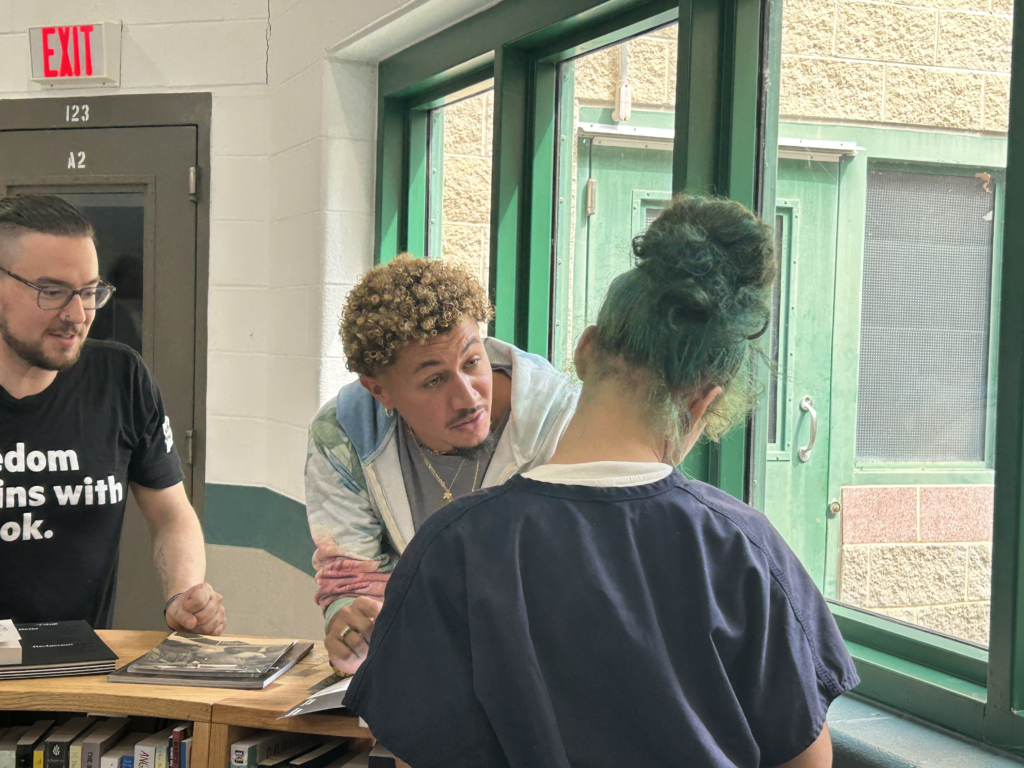
That’s why Freedom Reads has made it a mission to put hand-crafted bookcases called Freedom Libraries into the hands of inmates across the country. The national organization installed the first of its county-level facilities at the Camden County Juvenile Detention Center on Sept. 15.
Tyler Sperrazza is the chief production officer for Freedom Reads.
“Our entire mission is about bringing dignity to those who are incarcerated,” he explained, “and reminding them that the walls between the inside and the outside can be more porous, and books are the way to do that right.”
The county detention center got one Freedom Library for its female housing unit and another for the male unit. The facility currently houses four female and 28 male residents between the ages of 13 and 21.
Elizabeth Cheer is the site education supervisor for the center. She first approached the Freedom Reads team at a conference of individuals who work on prison re-entry.
“This is the proudest moment of my career, bringing these libraries,” she said.
Reginald Dwayne Betts, founder and CEO of Freedom Reads, was passed a copy of “The Black Poets” while incarcerated as a teen. The experience inspired him to move forward with his life by writing his own poetry. Betts got published before his release from prison and later became a lawyer.
Betts was then inspired to create Freedom Reads, with the goal of putting a Freedom Library in every correctional facility housing unit in the nation. So far, the organization has created 515 libraries in 51 adult and youth prisons, and stocked them with more than 278,500 books.
Several members of the Freedom Reads team, many former prisoners themselves, were on hand for the Camden County presentation. Library coordination manager David Perez DeHoyos explained the emotional impact that being incarcerated can have on an individual.
“It’s disorienting,” he noted. “It’s kind of, in a way, traumatizing, like the shell shock of being out, free in the community, then suddenly behind bars. So there’s … an isolation to it.”
Some of those present for the county unveiling designed and built the detention center bookcases, which are carefully created to be welcoming while allowing for conversation and book sharing.
“Imagine some of the stuff that these kids have been through, and then all of a sudden, they can read a book, and they can be in a different place, in a mindset …,” County Commissioner Jonathan Young observed. “We’re just hoping that this is something that may be a calming agent for them.
“This is something that maybe really starts to turn their life around.”
That the books are new paperback copies is an important aspect of Freedom Reads.
“We want to make sure that we’re showing folks on the inside that they are valued in a way, that they deserve new books, and they deserve to be the first person that’s opened that book and read that book,” Sperrazza pointed out. “We … want them to be able to have that experience.”
The library bookcases are filled with titles carefully selected to best serve the needs of the center’s juvenile residents. They include young adult books of several different genres: science fiction, poetry, non-fiction and literary classics.
The Freedom Library unveiled at the Camden County Juvenile Detention Center on Sept. 13 has a curated selection of books and genres.
“I really just want them to have their horizons open and to learn about things that maybe they didn’t even know existed before hand,” Cheer emphasized, “and just also to understand that people care about them enough to have brought these books, these libraries and this knowledge to them.”
One of the female juveniles at the center – identified only as JB – was offered recommendations from a member of Freedom Rides based on books she enjoyed.
David Perez DeHoyos of Freedom Reads and a detention center juvenile indentified at JB discuss books at the new Freedom Library.
During an an assembly-style presentation for inmates at the center, each of the formerly incarcerated members of the Freedom Reads team stepped up to the podium to share how books changed their lives.
Kevin Baker, another library production manager for the organization, shared a story about one library that was met with hostility and aggression by inmates – until the books appeared.
“I watched grown men go from violence to compassion and gratitude in 21 minutes,” he recalled, “because of these books.”
Domestic violence rates saw a record spike during COVID, when victims and their abusers were in close quarters at home. While that’s no longer the case, support remains crucial.
Three towns are playing their part. In Cherry Hill, Haddonfield and tiny Tavistock, police are working with the Side by Side Domestic Violence Response Team to help survivors navigate resources available to them. The team operates 24/7 to take calls either through its specific phone line or to respond when police get a domestic violence call.
The response team has been ongoing since the late 1990s, when it was created by attorney Nancy Hatch in partnership with former mayor Susan Bass Levin. It is now mandated by the state attorney general that every municipality have a team. Side by Side is unique in that it has a specific name.
Beth Hastings is the coordinator for the program.
“People should know that the services are available,” she noted. “A lot of times people don’t even know that our services are there.”
According to the most recent data from NJ.gov, 2023 marked a five-year high in domestic violence incidents reported to police in the state, at 70,828, compared with 67,512 cases in 2022. Nationally, statistics show that for the first half of 2025, incidents are up by 3% compared with the same period last year.
Ten volunteers currently make up Side by Side and each undergoes 40 hours of training, after which they can speak with victims in a confidential capacity. Volunteers are not counselors, but rather sources of support who provide information and give victims the emotional space to express their feelings in the moment.
Some volunteers can also be cross-trained on non-fatal strangulation, human trafficking and sexual assault. The team is available to help both men and women in either same-sex or opposite-sex relationships who experience violence at the hands of a partner. Volunteers will meet victims at a hospital or police department without pressuring them to make a specific decision.
For clients who don’t want to leave their relationships, the team can help create a safety plan, while giving the client control of how they manage their situation without judgement.
“We’re just empowering them with information,” Hastings explained, “or we’re just the shoulder to cry on or to listen … We never want to push anything on them.”
Clients who do want out of their relationships face major concerns like housing, legal services and the safety of children or pets. Side by Side can connect them with safe houses and shelters, walk them through what to expect from a restraining order or how to contact a pro bono lawyer.
For the most part, when the Side by Side team is dispatched by the police, officers have already contacted the units that specifically handle child abuse.
“There are male victims, female victims, children,” Hastings pointed out. “We don’t counsel the children, though. We only counsel the adults.”
For clients who need someplace for their pets while they’re in a shelter or safe house, Side by Side partners with Services Empowering the Rights of Victims (SERV) to offer safe, temporary options.
“A lot of clients won’t leave because of their animals, because the animals support them,” Hastings pointed out.
Clients who want more information can also receive a pamphlet with resources and information on staying safe, or find the pamphlet online at the Cherry Hill police website, under the Domestic Violence link in the Programs and Services section.
If you or someone you know is in immediate danger of domestic violence, call 911. To contact Side by Side directly for non-immediate services, call (856) 432-8869. To reach SERV, call (866) 295-7678.
Sen. Andy Kim held a town hall at Cherry Hill East on April 22 that drew a crowd of more than 300 people.
The Democratic senator took to the front of the auditorium of his alma mater to address his constituents.
“This idea (is) that we can gather together as people in this nation and talk through the challenges that are there, recognizing full well that we’re not all going to agree on it,” he said. ” … That we’ll have disagreements and issues and different perspectives here and there, but that we’re able to have this type of conversation and talk through what direction our country should be going.”
The senator was met with a range of emotions from the crowd. While many applauded or cheered, others yelled, booed or clapped loudly in disagreement with him. Before taking questions, Kim laid out his concerns about President Trump’s actions since he has taken office.
“First and foremost, with a simple yet profoundly important recognition, is that the President of the United States, Donald Trump, is abusing his power,” Kim noted.
Someone in the crowd then began heckling. Kim stopped his address, walked to the back of the room and spoke directly to the individual. The two briefly discussed a disagreement on the Constitutionality of the president’s actions before Kim returned to finish his introduction and take questions and comments.
The town hall took place just under three weeks after the senator and 13 other Democrats joined Vermont Sen. Bernie Sanders’ effort to withhold $8.8 billion in military equipment to Israel. The measure failed, but division over the issue among audience members at Kim’s event was clear. As attendees began asking questions, one woman stood up to thank Kim for his yes vote, saying it showed “moral clarity, care for human life and a willingness to listen to your constituents.”
Another attendee defended Israel’s actions and expressed concerns about the country not being able to survive in the event of an arms embargo. Kim responded with his belief that there is no way to resolve the war in Gaza with military action alone.
“I don’t discount the continued threat that Hamas … will very well pose,” he explained. “But again, what we’re seeing right now with this resumption of violence (and a) blockade (of) humanitarian assistance, it’s just going to fuel anger and hate that gives Hamas the ability to be able to regroup and be able to continue to sow their danger to the Israeli people and make it harder to be able to get … all the hostages out.”
Outside of the Israeli issue, another town hall attendee, Linh Nguyen, addressed the need for federal workers and social services in the midst of government cutbacks.
“I chose a career in public service, and so many of my co-workers chose a career in public service because we want to serve the public,” she remarked, “and we are not able to do that when we’re being illegally terminated.”
Other audience members took their time to ask questions about multiple issues, including protections for LGBT individuals, in particular those in the trans community; due process in the wake of the deportation to El Salvador of immigrant Kilmar Abrego Garcia; and protection of U.S. citizens’ private data.
Kim continued to take questions for a half hour after the town hall ended.
“Go out and talk to other people in your own communities, your friends, your families and others, as I am doing as well, trying to make sure we’re spreading the word,” he noted. “The fact that you showed up today, it gives me immense gratitude for you that you’re paying attention.”
The New Jersey Department of Agriculture is accepting applications for United States Department of Agriculture Specialty Crop Block Grants.
Specialty crops include fruits, vegetables, tree nuts, horticulture, nursery crops and floriculture. Most of New Jersey agriculture falls under the specialty crop category. This USDA grant is for agricultural organizations that represent multiple producers.
“Many producers in New Jersey fall under the specialty crop designation and have used this grant opportunity for financial assistance with marketing initiatives,” NJDA Secretary Ed Wengryn said. “In an effort to be proactive, we are issuing the RFP now, before our producers get caught up in the planting and early harvest season, and we encourage anyone interested to apply for these federal funds.”
To be eligible for a grant, projects must “enhance the competitiveness” of specialty crops and might include, but are not limited to: research, promotion, marketing, nutrition, trade enhancement, food safety, food security, plant health programs, education, “buy local” programs, increased consumption, increased innovation, improved efficiency and reduced costs of distribution systems, environmental concerns and conservation, product development and developing cooperatives.
Download the application at www.nj.gov/agriculture/grants/specialtycropblockgrants.html. The deadline for submitting applications is 5 p.m., April 10. Publishing this request for proposals does not commit the state to awarding any federal funds.
Special to The Sun Sangeeta Doshi (clockwise from top left), Andrew Passalacqua, Joyce Pierce and Colleen Bianco Bezich will receive the Camden County Freedom Medal for service to their communities.
Four residents from Cherry Hill and Haddonfield will be honored at the 2025 Camden County Freedom Medal Ceremony on Wednesday for improving their respective communities.
The award – created by the Camden County Board of Commissioners in 2001 – is being presented to 13 civic leaders who demonstrate ideals and actions that reflect the principles of Dr. Martin Luther King Jr. Since its inception 24 years ago, more than 1,200 Camden County residents have received the prestigious honor.
Among the 13 awardees for this year are Cherry Hill’s Sangeeta Doshi and Andrew Passalacqua, and Haddonfield’s Colleen Bianco Bezich and Joyce Pierce.
Doshi has served the Cherry Hill community for more than two decades through participation in an array of organizations, including the Domestic Violence Response Team, the District IV Legal Ethics Committee, Moms Demand Action, the Indian Cultural Center and Indian Temple Association, the Camden Air Quality Committee, Inspiring South Asian American Women, the New Jersey Leadership Program, the Asian American Alliance in South Jersey and the North South Foundation.
“I am humbled and honored to receive the Martin Luther King Jr. Freedom Medal,” said Doshi. “MLK’s philosophies incorporated many of Gandhi’s teachings that we were raised with. We were taught to always give back, volunteer and to leave everywhere better than you found it.
“I am grateful, lucky and blessed that with the support of family, mentors and colleagues, I can contribute positively to my community. Thank you.”
Passalacqua, a student at Bishop Eustace Preparatory School, is making a meaningful difference in South Jersey through his service project, Crayons for Courts. After observing a child as young as 5 years old endure the anxiety of a courtroom setting, Passalacqua was inspired to act. He raised nearly $3,000 to purchase more than 6,000 packets of crayons, 3,000 coloring books, 2,000 activity books and stickers. His first donation was to the Camden County courthouse.
Bezich is committed to championing diversity and inclusion, as well as serving underserved communities. As mayor of Haddonfield, she has supported events such as LGBTQ+ Pride, Juneteenth and Diwali. She also mentors refugee children through the Diocese of Camden’s Office of Migration and Refugee Services, and has supported organizations such as LUCY Outreach, where she served as a board member, and Cathedral Kitchen.
“I’m humbled and overwhelmed, and honestly still in shock,” Bezich acknowledged, “because I had nominated another individual who is so deserving of this award, and upon learning that she would be honored, I found out that I had also been nominated.”
Pierce, a former teacher in Haddonfield, former councilwoman and acting mayor of Lawnside, was nominated by Bezich. Pierce has shown a passionate dedication to the students and people of the borough, with a goal to always ensure that her students received a consistent, high-quality education.
Each year, the commissioners set out to identify county residents who exemplify the teachings of King, specifically those who’ve contributed over time to making significant, tangible improvements that benefit their communities. The awards are based strictly on volunteer work, excluding any remuneration.
“The individuals selected for this prestigious award display true commitment to making the world a better place through actions such as community service, teaching and more,” explained Commissioner Jonathan Young. “It warms my heart to know that we have so many incredible, selfless people who call Camden County home and who are dedicated to serving their communities.”
The 2025 Camden County Congressional Award will also be presented at the medal ceremony, scheduled for 6 p.m. at the Collingswood Ballroom, 315 White Horse Pike. Young is this year’s recipient.
Bill Brown (left) accepts the Best Collaborative Effort of the Year Award on behalf of Joe Murphy, who was unable to attend with Darlene Macrina Supnick (right).
The Nonprofit Development Center of Southern New Jersey (NDCSNJ) held its 11th annual awards ceremony in Mt. Laurel on Tuesday, Sept. 24 where they honored a number of notable leaders and nonprofits in South Jersey including Haddonfield’s “Ballroom Dancing for the Blind and Visually Impaired.”
This year, for the first time, the NDCSNJ honored two individuals or nonprofits per category.
“Since 2006, the NDCSNJ has been dedicated to supporting area non-profits in delivering essential services and fulfilling their missions,” said MaryAnn Ragone DeLambily, NDCSNJ Awards Event chairperson. “We are proud to play a part in helping them excel by providing networking, training, education, capacity building, promotion and more.”
“I’ve been in this space for more than 35 years, so my favorite thing about the event is bringing visibility to nonprofits that would not normally get any other visibility other than this,” said Nicole Nance, executive director of NDCSNJ. “We get to showcase amazing work that they do, they do it every day whether they make a dollar or don’t make a dollar, whether they have a big budget or a shoe string budget, and it’s so rewarding to be able to say, ‘Wow, look at this group, they’re doing it with or without millions of dollars and look at how many people they impact just because of their heart.’
” … The work (nonprofits) do every day–often behind the scenes and without much fanfare–touches lives in profound ways.”
This year’s award recipients included the following:
NPO Young Professionals of the Year: Kellie Haines (WheatonArts, based in Millville) and Rachael Glashan Rupisan (Alice Paul Institute, based in Mt. Laurel).
Best Collaborative Effort of the Year: Forgotten Angels Equine Rescue based, based in Medford (Darlene Macrina Supnick), Ballroom Dancing for the Blind and Visually Impaired (Joe Murphy, Haddonfield).
NPO Community Partners of the Year: Angelo Harold (Owner of TeamHarold Transportation and co-owner of Stand Out From The Crowd Rentals and Inflatables) and Dr. June DePonte Sernak (Center for Family Services, based in Camden).
NPO Executives of the Year: Lucy DuBose (Faces of Change Inc, based in Camden) and Patricia Legge (Volunteer UP Legal Clinic, based in Camden).
NPOs of the Year: Tri-State Canine Response Team, based in Cherry Hill and GateKeepers Ministry, based in Pennsauken.
Chairman’s Awards: New Jersey Center for NonProfits based in Mercerville and Volunteer Center of South Jersey based in Sewell/Jersey Cares based in Livingston.
The NDCSNJ was started 18 years ago when three people had a vision of bringing professional development for nonprofits to South Jersey, Nance shared.
“You have many people who start a nonprofit just out of their passion, out of their zeal, some people out of trauma, some people out of joy, some people, just out of their heart …,” Nance said. “They just want to do good and help people and want to do something to make their mark on the world. You’ve got to follow guidelines and follow rules, so we help with that.”
One of the two Best Collaborative Award of the Year awards went to Haddonfield resident Joe Murphy, as the initiative involved collaborative efforts from the Haddonfield Lions, who have a goal of helping the blind and visually impaired; dance instructor Gene la Pierre who had experience; and employees from Best Works Industries, that employs many blind workers as well as volunteers from the Haddonfield 65 Club, Rotary Club, Dance Haddonfield and Grace Episcopal Church who assisted as drivers.
More recently, the program has expanded from 10 to 30 dancers and has also involved the Haddonfield Memorial High School LEO Club to assist dancers from the cars up the stairs to the elevator and dance area, and the program has also expanded to the Philadelphia region.
To learn more about any of the nonprofits recognized, visit https://npdcsnj.org/.