As the township grows, so does its student population. Most concerning is the expected increase in enrollment at the district’s 12 elementary schools.
The issue became apparent after a March 2024 demographic study that identified five elementary schools at risk of overcrowding by the 2028-’29 school year: Clara Barton, Joyce Kilmer, Richard Stockton, Horace Mann and Woodcrest.
To begin addressing that, the district recently held three community discussions on what is called elementary enrollment balancing, and elicited input from parents and the community. The sessions were held at Cherry Hill East and West; the third was virtual.
Superintendent Dr. Kwame Morton took part in the virtual panel discussion, as did several members of the school board and the district’s director of secondary education, Dr. Neil Burti.
“So the true effort, or true work,” said Morton, “really has to do with us ensuring that we’re ready for the future, while also maintaining high quality of experience for students and high quality of education.”
The demographic study assumed all classes would be at full capacity of 22 to 26 students, though many of them – especially special-education classes – have significantly lower capacity caps, meaning the overcrowding would be more significant than expected.
Geographic considerations – along with maximizing transportation efficiency – will be major considerations in any long-term solution to balance enrollment, according to the district.
“We are absolutely considering the impact on students and families,” assured Morton, “and ultimately, our goal is to minimize disruptions to any of our students and any of our families, while also addressing the present needs that we have and the future needs that we have.”
No decisions were made during the three meetings, but possible solutions discussed included converting the Lewis Administration Building into another elementary school, grouping schools by proximity and revising school boundaries.
Concerns were also raised by parents of multiple children who have one student already in an elementary school and would like the district to ensure siblings can remain together.
“Our goal to the end of this process is to try to create a plan that disrupts the district as little as possible,” noted board of education president Gina Winters.
Further discussions are expected – including sessions for the public – but dates have yet to be planned.
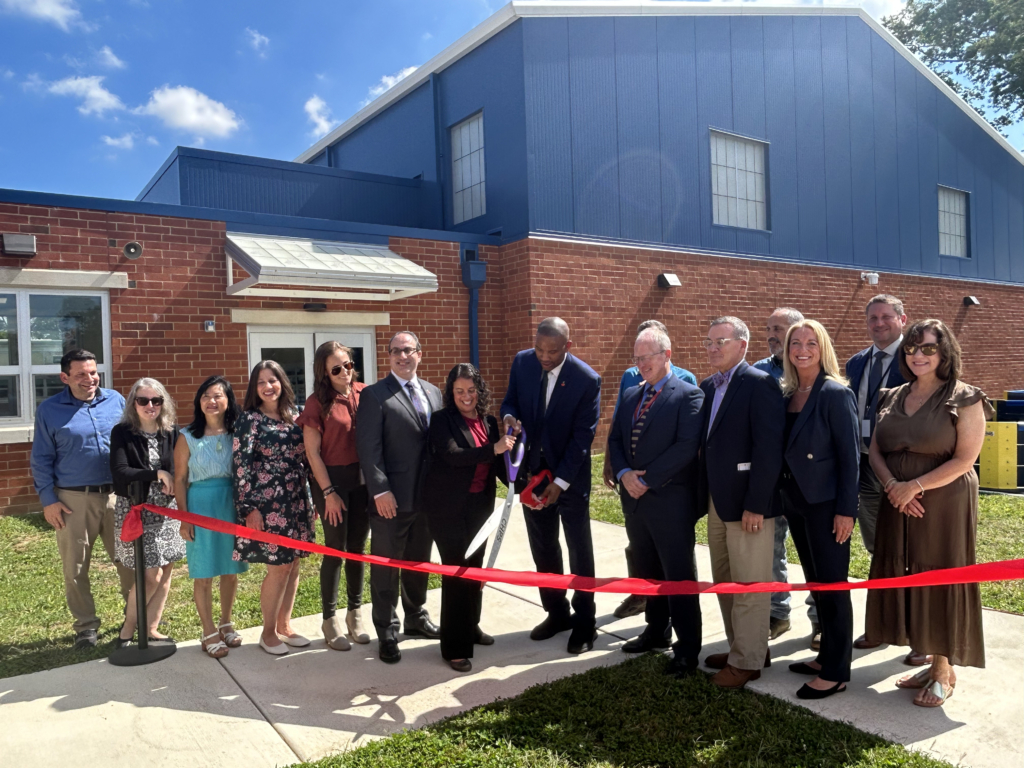
Abigail Twiford/The Sun Board of education president Gina Winters and Superintendent Dr. Kwame Morton helped celebrate the new room at Kingston Elementary.
Among major construction work at township school buildings this summer was the building of new all-purpose rooms in six of the district’s 12 elementary schools: Clara Barton, James Johnson, Kingston, A. Russell Knight, Horace Mann and Joseph D. Sharp.
The rooms were among projects paid for with a $363-million bond referendum passed by Cherry Hill voters in 2022. To celebrate their openings, the district held a ribbon-cutting ceremony at Kingston on Sept. 18.
While the all-purpose rooms have been in use by students and staff since the beginning of the school year, the ribbon cutting marked their official openings. They have a number of features that will help the schools run programs and activities for the entire student body.
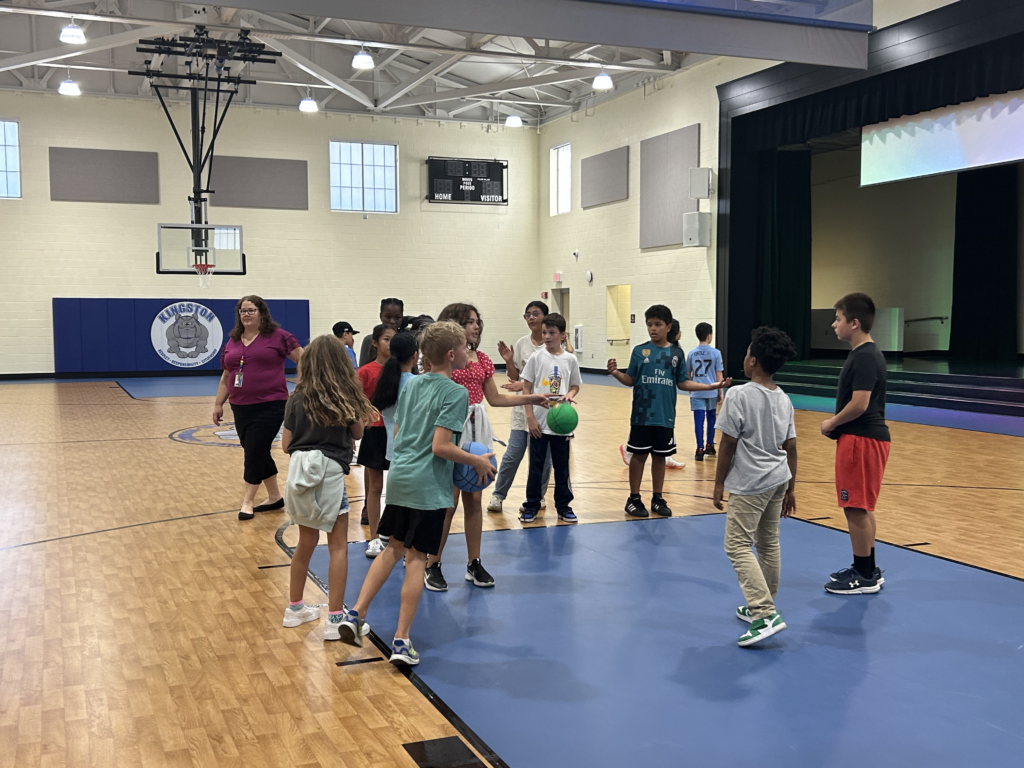
At Kingston, the new room consists of a full-size basketball court with a built-in stage accessible for those with disabilities. Its stage has a light system with different functionalities and the room has an integrated audio-visual system with Bluetooth connectable speakers, a projector and a drop-down screen.
It can be secured from the rest of the building using locked doors, has storage and office space for a physical education teacher and custodial staff and a single-use bathroom.
“It’s a game-changer in terms of a whole group assembly location we didn’t fit real well in,” noted Kingston principal Dr. William Marble. “It wouldn’t fit real well in the former APR. So to have that, and again, in a climate-controlled environment, is really phenomenal.
“In the past,’ he added, “we just limited that to a couple of grade levels so that we could fit them in that assembly. We can do a whole school assembly this year.”
Superintendent Dr. Kwame Morton began the ribbon cutting with a story about how he spoke with some of the fourth graders outside for recess before the ceremony. They asked him if those who paid for the new room would be there.
“I thought for a second and I said yeah,” Morton recounted. “And then – in a young lady’s infinite wisdom – she said, ‘My parents have to pay for this.’ And I said, ‘You are absolutely correct.’ And that’s exactly why we’re here.”
Morton thanked people who played a role in getting the referendum passed and the all-purpose rooms built.
“This is the story of us,” he explained. “This is the story of Cherry Hill, and who Cherry Hill is, and what we’re all about, that is a unified community which is highly supportive of its schools and of its students.”
Board of education president Gina Winters recalled the hard work that went into getting the referendum passed. A 2018 referendum to improve the schools was rejected by voters, so when the district was drafting the 2022 measure, community members were asked why the prior referendum had failed.
“The board engaged all corners of the community to identify our collective aspirations for our schools,” Winters pointed out. “The decision was made to do something audacious. As one former board president told me, ‘If you have a choice between safe and bold, choose bold.’”
Current and former members of the board gathered as Morton and Winters used an oversized pair of scissors branded with school district colors of purple and red scissors to cut the ribbon.
Kingston students play in the new all-purpose room following the ribbon cutting.
Kingston students then made their way to the room’s basketball court.
Artistic expression and the appreciation of visual arts can be vitally important for the development of school-age children, but not all students have access to art appreciation education.
To remedy that, Art Goes to School of Delaware Valley brings arts instruction to nearly 165,000 elementary-school students in the region. Cherry Hill has its own chapter of the Philadelphia-based nonprofit, which has been in operation for 50 years.
The organization’s volunteers go into classes from first to fifth grade to talk about art works, artists, mediums and forms, usually in a class art period with a teacher. Artistic reproductions are part of the lessons and are provided by Arts Goes to School, which is financed by grants and utilizes poster-board recreations of paintings; drawings; photographs; murals; and scaled-down, three-dimensional sculpture replicas.
Amy Bash is the grant manager for the organization and has been one of its volunteers for several years.
“We’re kind of a traveling museum …” she explained. “It’s a wonderful opportunity for kids who may not have been exposed to art, literally, from around the world, from caveman art to modern art to local artists.”
Art Goes to School’s goal is to help children develop 10 main skills through its teaching: observation; communication and language skills; visual communication; problem solving; imagination; making connections; learning about other cultures; collaboration; curiosity; and self-awareness.
Because the program is run by volunteers, it’s free to students and school districts. Art Goes to School operates during the academic year, with the township chapter beginning its meetings around the time school begins in September, then meeting once a week through December.
Discussions at the weekly sessions involve discussing the portfolio the organization has given the chapter for that year. Each chapter member chooses an artist or artwork, researches it on their own time, then addresses how to best present the choice for various grade levels.
“They discuss how to talk about the art with the students,” Bash noted. “There’s a very big difference between a special-ed class versus first grade versus fifth grade, and their knowledge about art and what type of art they may have been working on in the classrooms, so we customize the presentations.”
Portfolios are chosen and created by an Art Goes to School formal committee and rotate between the approximately 30 chapters in Pennsylvania and New Jersey. They feature a mix of various art styles and forms.
No experience or specific expertise is needed to become a volunteer educator with the nonprofit, which provides all necessary information and arranges all meeting places and classes.
“You don’t have to have an art degree,” Bash emphasized. “You don’t have to have been a teacher.”
Each instructor generally teaches about 10 classes in the academic year, with each one taking about 40 minutes.
“It’s not like you have to meet every day or every month throughout the year,” Bash offered. “Typically, we’re off when school is off as well. So it’s not a huge imposition in time. But it’s extremely rewarding.”
Bash went on to say that participation by volunteers can be a rewarding experience given the way they introduce art to students.
“The great thing about Art Goes to School,” she remarked, “is that while you can’t necessarily touch or talk out loud a lot in the museum, you can speak your heart and your mind, you can share your thoughts and you can touch the samples that we bring in.”
Volunteers also get an opportunity to socialize.
“Everyone is really nice, creative, knowledgeable and committed members of our chapter …” Bash observed. “We’re always looking to bring new people into the fold so that we can perpetuate this truly amazing benefit that the community and the school system receives.”
Anyone interested in volunteering for Art Goes to School can contact Libby DeLuca, the Cherry Hill chapter chair, at libbyd67@comcast.net.
Courtesy of Cherry Hill Public Schools Phase 1 of a four-phase plan is underway at Carusi Middle School and includes renovation of the A wing, gym, locker rooms and main office area.
Renovations and additions funded by the 2022 bond referendum of $363 million are continuing at township schools.
During a recent board of education meeting, Lynn Shugars, assistant superintendent and business/board secretary, shared project updates. The biggest initiative at the moment, she said, is the addition of all-purpose rooms at numerous schools.
“For the most part, we are moving indoors into the buildings and starting some of the work,” Shugars explained.
Work most recently began at Joseph D. Sharp Elementary, including a new roof on the building and the finalizing of brick and waterproofing. Upgrades at Clara Barton Elementary are a little farther along, with an almost-complete roof. Upcoming work includes wall panels, the installation of windows and bathroom tile and outside painting.
Work is still being completed outside of Horace Mann Elementary, including storm drainage and fencing. Once that’s complete, interior renovations such as wall painting will be underway. James Johnson Elementary is also coming along, with painting and bathroom tile being installed while wiring, ceiling grips and bathroom accessories are in the works. Wiring is also being worked on at Knight Elementary, where a drop ceiling, HVAC and gym equipment, bathroom accessories and interior doors are forthcoming.
Work at Kingston Elementary is the farthest along. The playground area has been turned over to the school; bathroom tiles are being put in; and finishing touches are going on the electric, drop ceilings, HVAC, bathroom accessories and interior doors. Kingston is also the first building to see the installation of theatrical equipment, including stage lighting and curtains.
“So we’re moving right along with those projects,” Shugars noted at the board meeting.
She then highlighted the four-phase upgrades at Carusi Middle School. The district is in the process of wrapping up Phase 1, which includes the renovations of A wing, along with the gym – which will also get insulated panels – locker rooms and the main office area.
Carusi is now preparing to begin Phase 2, which entails abatement and renovation of the school’s B wing, along with the renovation of C wing spaces between the cafeteria and gym. That work is set to begin in June and run through May of 2026. Next steps include the purchase of TCUs (temporary classroom units); installation plans for those are still being discussed.
Other work includes: additions and renovations at Rosa International Middle School (bid awarded Dec. 17); renovations to the front entrance at Beck Middle School (anticipated completion is February); lighting and ADA accessibility at the Cherry Hill High School West stadium (work to start after July 7); and upgrades to the J.F. Cooper Elementary front parking lot, Beck Middle School west parking lot, auditoriums at both high schools and the F wing at Cherry Hill East over the next two years.
Shugars also highlighted upcoming preschool additions that will be funded through a ROD grant that is separate from the bond referendum. Project work includes an eight-classroom pre-K addition at both the Estelle V. Malberg Early Childhood Center and Joyce Kilmer Elementary, along with the conversion of 13 individual toilet rooms at Malberg to preK-suitable facilities. The Kilmer site will also get two new playgrounds.
Further bond referendum project updates will be presented by Shugars at the first board of education meeting of each month.
In other board news, public information officer Nina Baratti presented findings from a recent communications audit and subsequent updates to the district’s strategic communications plan. Parents and guardians can expect stronger transparency regarding inclement weather announcements, health emergencies and similar events, and they will also receive weekly newsletters from both Superintendent Dr. Kwame Morton and school principals.
There is also now a Superintendent Spotlight on social media, highlighting individuals who are doing great work across the district.
Looking ahead, Baratti promised there will be listening opportunities to gather feedback from the public on what is and isn’t working, especially regarding the newly-launched district website. She’s also updating communications around the referendum projects that will eventually include fresh photos, videos and digital tours, both on a dedicated webpage and social media, to show how the work is coming along.
Other goals for the near future include the implementation of a district branding guide (standardized logos, colors and fonts) and enhanced engagement with non-English-speaking families.
The board also discussed the possible extension of the district’s Wireless Communications Device Policy – which bans cell phone use in the classroom – to its members during meetings. The goal is to set an example for students. A vote is expected to take place during the next meeting.
Courtesy of Cherry Hill School District Dr. Kwame Morton said he’s especially proud that projects funded by the 2022 bond referendum are coming to fruition.
After nearly two decades in the Cherry Hill school district, where he has served as an elementary- and high-school principal, Dr. Kwame Morton is in the middle of his first full academic year as superintendent.
In a recent interview with The Sun, Morton said he’s proud of the work that’s been accomplished so far, and looks forward to all that’s coming in the near and distant future.
A strong point of pride for Morton has been watching projects funded by the 2022 bond referendum of $363 million – the largest ever passed in New Jersey – come to fruition.
“The commencement of the work was aligned with my start as acting superintendent (in July 2024), so I’ve been intimately involved in the projects that have taken place thus far,’ he explained. “We’ve had massive roofing work done across the district, we’ve had gyms redone in multiple schools, we have new APRs (All Purpose Rooms) being built at six of our elementary schools.
“That’s only a third of the work that we have in front of us,” Morton added. “So seeing the projects get completed on schedule, on time, on budget has been awesome. It’s been fantastic for us.”
Another 2024 highlight was the district being cited as one of only a few statewide to receive preschool expansion funds. There are currently about 350 kids in the continually expanding program.
“That’s wonderful to have the opportunity to provide free preschool, universal preschool for the families of Cherry Hill,” Morton emphasized. “It’s tremendous.”
Morton also spotlighted the hiring of several new principals, including Christina Collazo-Franco at Carusi Middle School, Alison McCartney at Woodcrest Elementary School and Daniel Finkle at Cherry Hill East.
“They hit the ground running. I think things are going very well in our schools,” noted Morton, who reported that he has sought out like-minded individuals who “possess and embody the same energy and mindset.”
“I’m proud of the comprehensive change as I think about it all,” he observed, “and how we’re systematically addressing everything and managing it all and moving forward, and attempting to provide kids the greatest experience possible in the district.”
Source: Google Maps
Looking ahead at the rest of 2025 and beyond, Morton said his administration is “deeply entrenched” in crafting a new five-year strategic plan. The current one expires this year.
“That’s a massive effort,” he acknowledged. “It involves tremendous community voices, survey process, individual meetings, focus group meetings, reviewing data, establishment of focus areas, establishment of goals, indicators of success. All of that is happening as we speak.”
The administration is also crafting its first “Portrait of a Graduate” profile, to identify the characteristics, attributes and qualities the community wants for students as they progress through the school system. It will also include skills students should acquire during their education that will help them navigate the world after graduation.
Community meetings over the past few months have enabled parents and other stakeholders to have their voices heard, a process Morton estimated will end by May or June. And he is in the early stages of exploring possible elementary-level redistricting in the 2028-’29 academic year.
“We had a demographic study that was done last year, and this demographic study follows population trends,” he offered. “We were able to see that in the 2028-’29 school year, we’re projected to have significant enrollment increases at the elementary level, particularly because of the preschool program that we started. And as the children matriculate upward, of course they’re going to land in specific schools.
“So we’ve begun the planning process around elementary redistricting, and more to come with that.”
Under consideration to alleviate overcrowding is the transition of the Arthur Lewis administration building – formerly an elementary school – back to its original use. Other adjustments, including new transportation routes and updated boundaries for schools and neighborhoods, will also be discussed.
“But we are nowhere close to being ready with recommendations yet,” Morton stressed.
The school district will continue to enhance its communication strategy, he emphasized. A “revealing” audit completed last year led to some vital updates of the district’s digital presence and communication with the public.
“Community members found it very difficult to navigate our district website and found it difficult to find information,” Morton said. “So one of the things that we’ve done as a result, we have a new website. A new website just launched on Jan. 2 when we returned back to school.
“So this new and improved website has received positive feedback and was an outgrowth of that process.”
As Morton’s inaugural school year as superintendent enters its second half, he says he’s honored to helm a district where the students, parents and staff feel strongly about academic success.
“Cherry Hill’s a great community, a wonderful community of passionate individuals,” he stated. “Many people move here for the schools and experience for their children. That’s just the type of place that Cherry Hill is.”
The Cherry Hill African American Civic Association is accepting submissions through Monday, Jan. 6 for its annual Reverend Ivan George Essay Video Poster Contest.
To compete, township K-12 students submit an essay, poster or video on Black Olympians and Paralympians. Past topics have included African American inventors, African Americans in S.T.E.M. (Science, Technology, Engineering, Math) and African Americans in health care.
This year marks the 11th essay contest. It is named for George, a long-time member of the civic association who originally proposed the competition. He died in 2020.
“We’ve had well over 100 entries each year,” said Cathleen Jenkins, financial secretary for the association.
The winners will be announced at a board of education meeting on Tuesday, Feb. 25, in conjunction with February as Black History Month. Both contest winners and other entrants will be highlighted at next summer’s Juneteenth parade and festival at Croft Farms.
Jenkins noted that through the years, the essay contest has given students an opportunity to learn more about Black history, both locally and in the broader community. For last year’s theme of African Americans in the community, she found herself and a friend being interviewed by her grandchildren, while other students opted to interview the superintendent of schools.
The contest has proved to be an educational experience for all, including Jenkins and the parents of essay writers.
“If you don’t know your history, and I don’t mean as African Americans, I mean as Americans, if we don’t known our history, we may repeat those things,” Jenkins noted. “Sometimes I see people who make blunders. Let’s say they don’t know a derogatory term, because they don’t have anybody from their era to say, ‘Don’t call them that.’
“Once they learn our history,” she added, “they’re more sensitive to what happened, and you appreciate how far you’ve come, and we appreciate the struggle. We see the accomplishments at the end, but we didn’t know how many people passed over, how many people died, how many people weren’t given their proper due.”
The essay contest is in partnership with the Cherry Hill library, where judges will review essays later this month. To become a judge, reach out to Jenkins at cathy.jenkins@chaaca.org. To learn more about the contest, visit https://chaaca.org/ova_sev/chaaca-essay-contest/.
Cherry Hill Public Schools will be hosting a public information session on Monday, January 8 at 6 p.m. at Cherry Hill High School West’s new auditorium, which faces the Jefferson Hospital.
The session will cover the following topics:
Overview of preschool expansion and private providers
Roles and responsibilities
Registration and application process
Question and Answer
The program starts at 6 p.m. and is a parent/caregiver event only. Prospective preschool parents and guardians are also invited to attend.