Tag: cherry hill library

  • An early New Year’s Eve at the library

    Abigail Twiford/The Sun
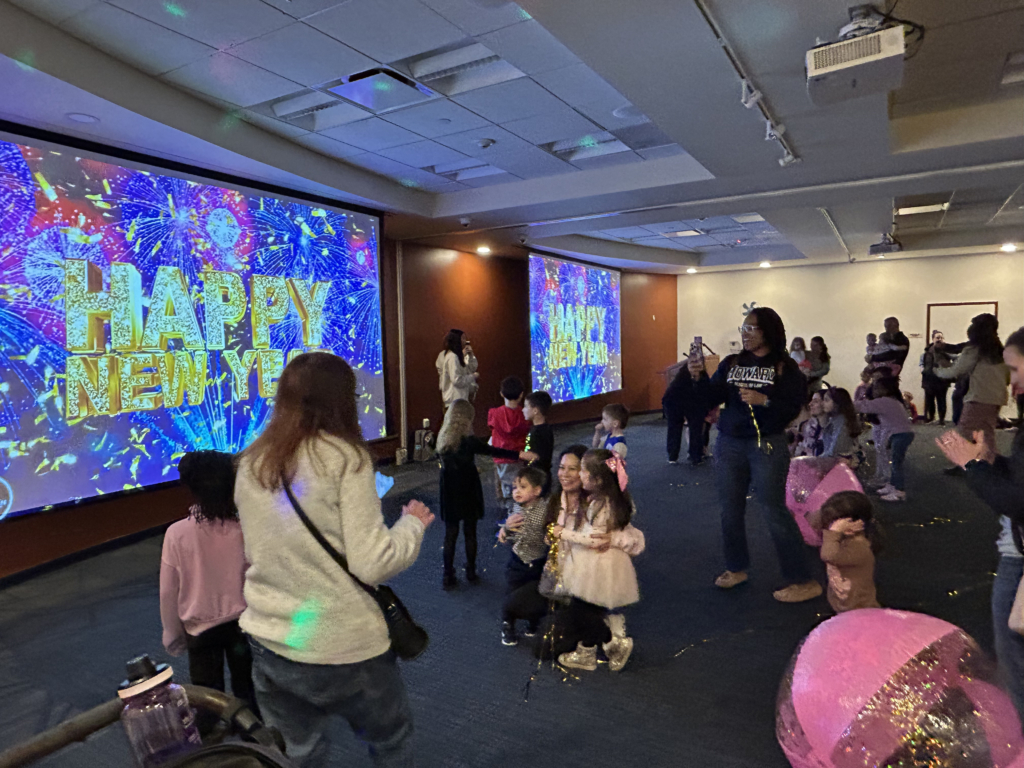
    The free New Year’s Eve event – while aimed at the youngest library patrons – was an opportunity for families to celebrate together.

    Children in the townshp celebrated the new year 12 hours early on Dec. 31, with a Noon Year’s Eve event at the library.

    It marked youth services librarian Katie Helf’s first year hosting and organizing the party.

    “The whole idea is just to give the kids a chance to celebrate the New Year in a relatively healthy way, because they’re not staying up past their bedtime or getting off their routine,” she explained.

    Held in the library’s lower conference center, the party featured music to dance to and colorful lights for a festive mood. A photo station was set up for families, who were invited to celebrate with their children. Several inflatable pink balls got kids bouncing, throwing – and laying. 

    Helf led the children and their parents in games of Head, Shoulders, Knees and Toes and freeze dancing, engaging participants in interactive games.

    “We had a lot of fun just playing, so that was good,” Helf noted. “And the dancing and the kids were funny, with all the different stuff they were doing, throughout the whole event.”

    As noon approached, Helf showed a video of dancing animated animals and a child announcer who led the New Year countdown of 10 seconds, with library participants calling out the numbers in unison.

    The free event – while aimed at the youngest library patrons – also included some parents, older siblings and even grandparents on hand.

    “It’s wholesome,” Helf observed. “It’s for the whole family. It’s fun, and it’s short, too. It’s not like you’re here for hours, you’re here for half an hour, a good family outing right before lunch.”

  • Library hosts class on computer backups

    Abigail Twiford/The Sun
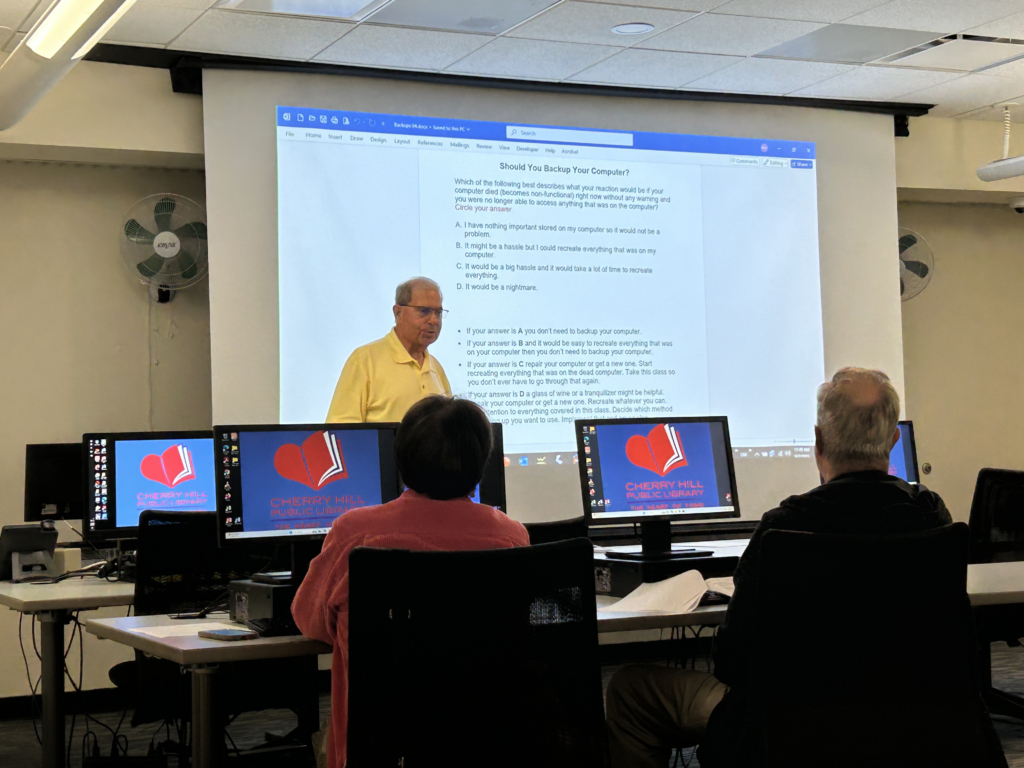
    Instructor Peter Mokover hosted the class, acknowledging that while no method is a guarantee of security for devices, backups are recommended.

    The Cherry Hill library’s many offerings include sessions that teach people how to use technology and software and protect their electronic devices.

    “Back up Your PC: Protect Your Information,” taught by Peter Mokover on Sept. 3, explained to the 12 people in attendance their options for copying data outside of a computer to protect against a device getting lost, damaged or broken. 

    Mokover – who routinely addresses the topic at the library – began by asking how attendees would feel if their computer was to suddently stop working. He explained that there are generally two ways a computer can be backed up, either by copying all of the data to an external solid-state drive (SSD) or hard drive, or by backing information up to the cloud. 

    Creating a backup with an SSD requires the user to plug in the external drive and export the data onto it themselves, then store the SSD in a safe location.

    “Most people have at least one bed in their house,” Mokover said. “You can put it (the SSD) between the box spring and mattress, or put it as far away from the computer as you can get. Or give it to a friend. But lock it before you do that,” he added, noting some of the possible safety locations.

    Backing up to a cloud service is an option that allows the user to save information to a computer that is not in their own home, with the backup completed online after the user subscribes to an available service.

    “The single biggest advantage of cloud-based backups is that it is located somewhere else,” Mokover noted. “If your house literally caught on fire and burned down to a pile of dust, your computer that’s in the house probably didn’t survive, but at least all your data is backed up somewhere else.”

    He acknowledged the advantages and disadvantages of each backup type, including the difficulty in finding a secure place for a physical hard drive and the risks of having personal information stored on a computer owned and operated by a stranger, as happens with cloud backups.

    Mokover also acknowledged that no method is a complete guarantee of computer protection, backing up a device is still a better idea than not. 

    “I like to go to these classes,” said resident Audrey Giza. “It’s being taught right, it’s being taught professionally. We have outlines, we have something to go on instead of just winging it. And I think he (Mokover) is excellent.”

    After his presentation, Mokover answered questions and addressed other concerns from the class, such as the best places to store passwords for cloud services or external drives, including with friends or in a safety deposit box.

    “I think the class went well,” he noted, “and I think if nothing else they got, they understand how important it is to back up their computers.”

  • Library screens film about Korean women divers

    Courtesy of the Cherry Hill library’s Facebook page

    The Cherry Hill library screens what it calls a must-watch documentary every month. On May 29, it was Apple TV’s “The Last of the Sea Women.” 

    Subtitled by the library, the film follows a group of Korean women called the haenyeo, divers who harvest seafood like sea urchins, shellfish and seaweed by holding their breath for two to three minutes at a time after diving as deep as 30 to 40 feet below the surface.

    Many of the women live on and dive from South Korea’s Jeju Island, where the haenyeo traditionally originate, though some of the younger women featured in the documentary come from other areas of the country, specifically Geoje. 

    Library guests had already read Lisa See’s novel, “The Island of Sea Women,” which covers the haenyeo and Jeju Island. 

    “I try to find things that I know people will be interested in,” said librarian Jaclyn Harmon, circulation supervisor for the library. “I knew about the Lisa See book and I saw that this documentary was on Apple TV, so I thought it would be a good choice.”

    As May marks Asian American and Pacific Islander Heritage Month, the documentary was also chosen for its connection to Korean culture. 

    “Especially because May is AAPI month, so we’re trying to find something kind of that falls in those parameters,” Harmon explained. 

    The documentary highlights the concerns and lives of the ‘sea women,’ from the physical effects and danger of their jobs to the fear of their culture slipping away and being forgotten. Most of the film’s haenyeo are well into their 60s, 70s or even older, and many younger women have no interest in the trade. 

    Environmental struggles are also explored in “The Last of the Sea Women,” with trash shown accumulating along the beaches of Jeju and the divers in the film addressing how it’s become more difficult to find seafood, thus lowering their income.

    Their greatest environmental concern is Japan’s plan to release wastewater from the Fukushima nuclear power plant disaster into the ocean. While diluted, the water is still radioactive, and it will impact not only the livelihoods of the film’s haenyeo, but their health, too. 

    Barbara Elkan was at the library for the documentary screening.

    “I’m very grateful to the Cherry Hill library for showing this movie,” she stated, “because it would be something I would never think of. I would never know about it otherwise. It’s very, very interesting and I learned a lot.”

    The library’s next must-watch documentary, “Will and Harper,” will be screened on Thursday, June 19. The 2024 feature follows actor and comedian Will Ferrell as he and his friend, writer Harper Steele, take a a 17-day road trip across the country, with Steele having recently completed a gender transition.

  • ‘Pure nostalgia’

    To wrap up its celebrations of Jewish American Heritage Month, the township library held an event on the history of the Jewish community in Camden County.

    Ruth Bogatz was the featured speaker for the talk, “Growth of the Camden County Jewish Community.” She is a lifelong resident of the county who was born at Cooper Hospital in the mid 1930s.

    “If you’re looking for dates and you know, a chronological history, you don’t get that from me,” Bogatz said. “I consider myself a social historian.”

    She started off the talk by noting that the Jewish communities of Camden, Gloucester, Burlington and Salem counties are her passion, then recited a song her friend, Irving Epstein, wrote about Camden.

    “We left our hearts in Camden,” it goes. “Our happy years were jammed in, with memories good and sweet.”

    Bogatz went on to describe how the early years of Jews in Camden City in the 1880s saw a community small in number and average in means, but able to build a strong foundation for the much larger and stronger Jewish community that now exists in the region.

    “It would be impossible for me to give you a complete history of the Jews of Camden or to mention everyone who contributed to it in the time given to me,” Bogatz acknowledged. “The names I mentioned are few and only used as markers.”

    She described how many of the early members of the Jewish community started businesses, making and selling everything from steel pens to shoes, and running a taproom and bathhouse. She recounted how many of them moved to Camden from various farming settlements around South Jersey to find opportunity and employment. 

    “Camden, the city of my birth, now one of the poorest cities in the nation, was a wonderful place,” Bogatz recalled. 

    She also talked about the building of the first synagogues in the city in the early 20th century.

    “In an early map of the city, that location is marked by the words ‘Jewish church,’” she pointed out.

    By the 1920s, there were 2,000 Jews in Camden out of a population of 118,000, with three synagogues between them. Bogatz also spoke of the Jewish Federation in the region at the time, its role in the community and the city’s first rabbis.

    “When the war ended, the community gathered to remember those who made the ultimate sacrifice and to honor those who had served,” she emphasized. “They rallied to aid the displaced persons who survived the Holocaust and 24 families were welcomed to begin new lives in Camden.”

    Bogatz described the celebrations in the city’s streets when Israel was declared a new nation in 1948, with 450 students from the Beth El Hebrew school waving the flag. She talked about the Jewish community center that opened in 1956 with a nursery school, athletic facilities, meeting spaces and a swimming pool. 

    Members of the library audience recounted their own memories and tales of the history Bogatz spoke about, including Larry Miller, a past president of the Sons of Israel organization.

    “Everything you said was pure nostalgia …” he told Bogatz. “I distinctly remember the corner of Kaighn Avenue and Broadway. And I can still name old stores, Jewish stores.” 

    Sabrina Spector, executive director of the Jewish Community Relations Council of Southern New Jersey, helped organize the talk.

    “I think it was wonderful for our community to hear about our roots and our foundation to hear about the contributions we’ve made to the community,” she noted, “and how much we’ve grown into what we are today.”

  • Library hosts 10-week class on novel writing

    The Cherry Hill library has offered a wide variety of educational programs and classes for residents of all ages for years.

    One such program is the Novel Writing 101 class, a 10-week series that aims to help those interested in writing and publishing a novel create stronger stories, prose and characters. 

    Ty Drago – a novelist, editor and publisher – teaches the class.

    “I retired,” he said. “I became a full-time writer, yeah. And you know what you can’t do for eight hours a day is write, so you have to look for other things. I like to teach.” 

    Drago has instructed the adult novel-writing class for seven years. He also runs a six-week, short fiction- writing class and has done a number of seminars for children.

    His class is the first of its kind at the library that is free. Drago focuses on different elements of writing week to week, using lecture notes displayed via slideshows and writing exercises to help participants better understand the topics at hand. 

    Drago goes over his five rules for writing: write; finish what you write; edit what you write; submit your writing for publication; and then, go write something else. One class exercise involves taking a long passage and shortening it while keeping the same tone and vibe. 

    “Vibe is very internal,” Drago explained. “It’s not about what’s out here, it’s about what’s inside the character … The point of view is tight and you are inside and feeling everything they (characters) are feeling.”

    Another class assignment is to write 100 words in a way that conveys a broad image to the reader or writing the same length with more emphasis on detail. 

    Drago said this year’s class averages about 18 people a week. Since it takes place over 10 weeks, each class does not always draw the same set of students, though some are consistent participants. It also helps with things like outlining the books students want to write and coming up with milestones.

    Drago also goes into detail on the difference between show versus tell and when to use each.

    “Tell gets a bad rap,” he noted. “Tell has its place … if you’re writing a short story for an anthology that has a limit of 1,500 words, and you’re at 2,000 and you gotta cut off a quarter of that story. You start looking at the shows versus the tells.”

    Showing the audience something often takes up more words than telling it. Students are encouraged to read their writing – both from home and with in-class exercises – aloud for the rest of the class to hear. Drago then critiques the passages, telling students what they did well and what they need to work on. 

    He emphasizes the importance of having a “first read,” the first person to read a work other than the author, and specifically mentions how necessary it is that that person be willing to be honest. 

    The end portion of the class is set aside for the attendees to split into groups and share their ideas and what they’ve been working on. Drago helps when they have questions or want feedback on their work.

  • Township library pantry addresses period poverty

    Period poverty has been an issue throughout the world for decades, but in recent years, New Jersey has made several efforts to reduce its impact.

    Period poverty occurs when menstruating females are unable to afford adequate sanitary products or don’t have access to hygiene facilities and education. The situation can lead to health issues like urinary tract infections and depression. An estimated 25% of women have trouble accessing or affording products. 

    To combat the problem, the Cherry Hill library partnered with the Alice Paul Institute’s Girls Leadership Council in 2023 to create a period pantry for teen patrons. Jasmine Riel is a teen librarian who helped set that up.

    “I think it took a while for people to really understand that it was a permanent fixture in the library,” she recalled. “It wasn’t just like a drive and a project that the students who helped organize it did for a short period of time.”

    For most of its existence, the pantry has been located on shelves in the library’s upper-floor teen section, where it provides various sizes and types of tampons, pads and panty liners. Due to construction, it has been temporarily relocated to a table in the same section. 

    Riel says the pantry is clearly necessary; she can see products being taken week to week, especially maxi and regular pads, regular tampons and menstrual cups from Alice Paul, the only reusable option in the pantry.

    “We would like to offer more reusable products, like period panties and things like that,” Riel noted. “It’s something that we’ve definitely talked about.”

    Donations from Alice Paul continue to be the main source of pantry materials, though individual donations are also accepted. Since it began, the pantry has proved to be valuable even to those who aren’t in need of its products.

    “We’ve also had parents tell us that it’s been a great visible educational tool for them to share with their own children,” Riel explained, “especially if they have children who don’t (yet) menstruate. They can say, like, ‘Hey, you have friends who have periods. Can you imagine how much money they have to spend on these all the time?’”

    Riel believes the pantry is a tool not just for information, but for teaching empathy that can in turn help break existing stigmas around menstruation.

    “We don’t just say feminine products anymore, we say period products,” she emphasized, “because that’s what it is. It’s a biological experience that people have.”

    In addition to local programs, there have been efforts statewide in the last two years to combat period poverty. In the summer of 2023, Gov. Phil Murphy signed a bill that requires school districts to provide free menstrual products to students in grades six through 12. And last year, New Jersey became the first state to allow use of welfare and cash assistance programs to buy period products.

    Since much of the pantry’s stock comes from Alice Paul, a nonprofit, there is concern that recent upheaval in federal government grant allocations may make it more difficult to routinely stock its products.

    “They (Alice Paul) are a nonprofit, so with things kind of going on in the world right now, it’s hard to tell how frequently they’ll be able to buy and supply certain things,” Riel acknowledged.

    Though donations were initially discouraged when the pantry first opened due to limited space, Riel now encourages them, as well as donations to Alice Paul.

    “It’s important to donate something like menstrual products,” she observed. “That kind of want to help people is really special, and it’s very unique. It’s a very unique way of giving back to your community.”

  • ‘Everything survives’

    To honor the anniversary of the assassination of President Abraham Lincoln, the township library hosted tour guide and reenactor Michael Jesberger on April 30.

    Jesberger offers 45 lectures on various aspects of the Revolutionary, Civil and World War eras. Though the anniversary of Lincoln’s shooting was April 14 – he died the next day – Jesberger’s talk was held on the last day of the month due to scheduling.

    He began by addressing major historical events that took place over the years in April, from the Battle of Lexington and Concord to the sinking of the Titanic. He then transitioned to the Civil War and the Lincoln assassination plot.

    “In my opinion, it’s absolutely tragic that this president who got us through those four (war) years is given the news that Robert E. Lee surrendered to Ulysses S. Grant on April 9 … And then he’s killed. He has no time to enjoy it,” Jesberger noted.

    He then went on to talk about how Lincoln was not the only target for assassination. Accused killer John Wilkes Booth did not work alone, and it is believed he and others planned to murder leading members of the federal government, including Grant; Vice President Andrew Johnson; and Secretary of State William Seward, who was seriously injured.

    Jesberger used informational slides and images of surviving era artifacts throughout his talk, including clothing.

    “Everything survives,” he maintained. “The flag, the (president’s) shirt collar, her (Mary Lincoln’s) dress …”

    His images also included one of the 44-caliber pistol Booth used in the assassination, and Jesberger described how the assassin crept through a door at Ford’s Theater in Washington, D.C., locked the entrance to the president’s private box and timed the shot into Lincoln’s head when he knew – as an actor – the audience would be laughing.

     Booth then escaped by jumping from the balcony and onto the stage, breaking his leg.

    “He goes over the balcony,” Jesberger recounted, “but when he does that, he catches his spur in this brand new decoration that was there that night. He catches his spur in the bunting, and it throws him off balance.”

    Jesberger also talked about Lincoln’s last hours in a bed that was too small for his lanky frame at a home near the theater, because he couldn’t be brought back to the White House fast enough. Lincoln’s wife, Mary Todd, was asked at one point to leave the room because of her emotional outbursts. Lincoln’s younger son Tad, saw a different play that night and was not initially aware of the tragedy.

    Jesberger also described Booth’s escape and his April 26 killing, when a New York cavalry soldier went against direct orders, shooting and killing Booth when he saw the assassin hiding in a burning barn in Virginia.

    “Sgt. Boston Corbett, was present,” Jesberger explained, “and he believed that he was an instrument of Jesus Christ. He was on this planet to do God’s bidding. So he ignores the orders.”

    As he neared the end of his talk, Jesberger acknowledged he didn’t have time to go over the entire episode of Booth’s killling and the trial of his co-conspirators. He looked to librarian Katherine Grady as he mentioned his enthusiasm for a possible part two of the discussion.

    “We’re so glad to have history programming that appeals to so many of our patrons,” Grady said. “Michael was so animated and interesting. I’m sure we’ll bring him back.”

  • Library holds first craft fair of year

    Cherry Hill hosted its initial craft fair of the year at the township library on March 30, an event that benefitted the facility.

    Meredith Meyer is the library’s volunteer coordinator. She was also one of the main organizers of the free fair, and began gathering vendors in late February.

    “It’s technically a fundraiser for the library,” she explained, “so vendors pay money, and we use that to make money so that we can provide other programming for free.”

    Meyer was also in charge of setting up the library for the fair and ensured things ran smoothly. 

    “It’s been crowded since we opened,” she said on the day of the event. “There was a line outside the door when the library opened … It sells out as far as vendors in about two weeks, so it’s a hot commodity. People want to come to it.”

    The fair took place on the library’s main and lower levels, in its lobby and in meeting rooms, where craft vendors from small businesses and crafters from all over South Jersey were on hand. Fifty-five sellers offered various handmade goods for sale.

    Katie Carpenter and Linda Flatley were selling birdhouses made out of wood from old barns and other farm structures. 

    “My dad lives on a horse farm,” Carpenter noted, “and they’re solid oak. And he only takes them down when a horse breaks one. So then he takes the wood and makes it into bird houses … He has entirely too much time on his hands, and he’s having a great time doing it.”

    “Farmers don’t like to waste things,” Flatley added.

    Other items for sale included crocheted clothing, plushies and accessories, novelty ceiling-fan pulls, baked goods, teas and flavored butters. Sharon Davis’ offerings varied, but centered on soaps and lotions she made herself at home. 

    “My main focus is being an inspiration to people when they use my products,” she said. 

    Art was also represented and sold throughout the fair, in different mediums and techniques from fiber art to digitally created graphics turned into prints. Jena Wong sold candles and stickers she began making during COVID in 2020. Her table also featured clip-on earrings with a clear resin in a horseshoe shape to stay on the ear.

    “My sister, she can’t have her ears pierced,” Wong pointed out. “So she found a concept from Japan. So these are not your traditional clip-ons, where they pinch you and your ears hurt afterwards.”

    Several fair vendors promoted the sustainable practices used in the creation of their goods. Aimee Eckert creates blouses and skirts from thrifted or second-hand quilts and blankets, as well as new pieces of jewelry from old and broken antique pieces. 

    “I’ve met so many new and nice customers and people that are really appreciating my work here,” she observed. “It’s been crowded, and everyone’s been super, super nice.” 

    The fair began at 1 p.m. and ran for three hours. Another is usually held in late fall or early winter, in time for the holidays.

  • Library holds kids’ event for Makers Day

    Makers Day is New Jersey’s annual celebration of STEM culture and the process of creating and learning throughout life. 

    Its 11th year was celebrated from March 21 to 23 at the Cherry Hill library, among other locations. The first Makers Day was held in 2014 after a grant from LibraryLinkNJ, with the goal of boosting community engagement with libraries, museums and other entities that foster exploration and ingenuity. 

    The township library celebrated this year’s event with a series of activities for patrons of all ages throughout the building. The day started with a drop-in coloring station for adults in the Reading Room, where magnet crafts that could be completed at home were also offered.

    At 10:30 a.m., the library had volunteers on hand to guide participants through various origami projects and shapes, ranging from beginner to advanced. The station was informal, didn’t require registration and provided paper and all other supplies. For children in third through sixth grade, a two-hour event inspired curiosity and taught types of hands-on creation. 

    Erica Moon is the youth services supervisor for the library. 

    “It really started with more robotics types of things,” she recalled. “And then we, in Cherry Hill, wanted to kind of get away from all the little plastic bits, so we started calling it more of a how-to festival. So now we’re just learning about the science behind some simple things.”

    The first hour of the library event was dedicated to the theme, “Persistence of Vision.” Children and parents were instructed by Moon and the volunteers on how to create kineographs, also known as flip books. The children then created stories by drawing pictures with colored pencils on index cards, and each consecutive card varied slightly from the image before it. 

    When finished, all the cards were attached with binder clips, with the children holding them at the clipped side and using their thumbs to quickly flip between them, creating the illusion of movement and making the images come to life. 

    “It’s the simple process of anime animation and just making still frames into a running animated film, basically …” Moon said. “We make the image the same on every card and just move it a little bit,” 

    Flip book stories started with simple cartwheels and bouncing balls, but quickly shifted to more complex tales as the children got more comfortable with the process.

    Susan Turner brought her daughter and son to the library.

    “I brought my kids to make flip books …” she explained. “They really enjoyed it. I like seeing his (her son’s) creativity. He had an idea in his head, and kind of seeing it come to life as he’s drawing it, and as he draws, he started adding more elements, like the one with the boat.

    “He did the boat moving,” she added, “but then he’s like, ‘I want to add a tsunami.’ So he starts drawing a tsunami coming in and she (her daughter) is just having a great time making a whole bunch of different stories.” 

    One of the children present, Chloe Turner, created several different books. 

    “It’s fun,” she noted. ” … So this one is a flower and a ball, and the petals fall down. And this one is an alien, yeah, going out of this day ship, and then going back in. And then this is a balloon, and a boy and the balloon just flows away, and then it pops.” 

    As the first hour ended, Moon began instructing the children on how to create varied models of paper airplanes, including the dart, the bull nose and the hunter. Flyers with instructions on how to fold paper into each different type of airplane were passed around, with volunteers offering help when needed. 

    Once all the kids created a plane model, Moon led them in a race to see which creation best flew, introducing them to the concepts of thrust, drag and lift. After everyone had raced at least one of their planes, she revealed a surprise model that had not been mentioned or shown to the group: the Nakamura Lock, a model she felt flew better than any other.