The Camden County Library System has a new reciprocal borrowing agreement with its counterparts in Burlington, Gloucester and Atlantic counties.
Effective this month, the agreement invites Camden County cardholders in good standing to conveniently obtain a card in the neighboring counties and access a wider selection of materials.
“Libraries are the heart of our communities, and this partnership helps to strengthen libraries throughout our area,” said Commissioner Jennifer Fleisher, liaison to the Camden County Library System. “We’re excited to offer this program to our residents, giving them access to thousands more books and resources at no additional cost.”
The agreement is much like the reciprocal borrowing pilot program launched in 2024 that included Camden and Burlington counties, along with several counties in North Jersey. Because each library’s policies differ, access to certain services like eBooks, digital streaming services, museum passes, technology items and other online resources may be restricted.
“Partnering with our neighboring counties was the clear next step in expanding access to library resources,” explained Linda Devlin, director of the Camden County system. “We know that our community’s needs do not stop at the county line, so by sharing our resources, we are able to strengthen the need for equitable access to library services to all.”
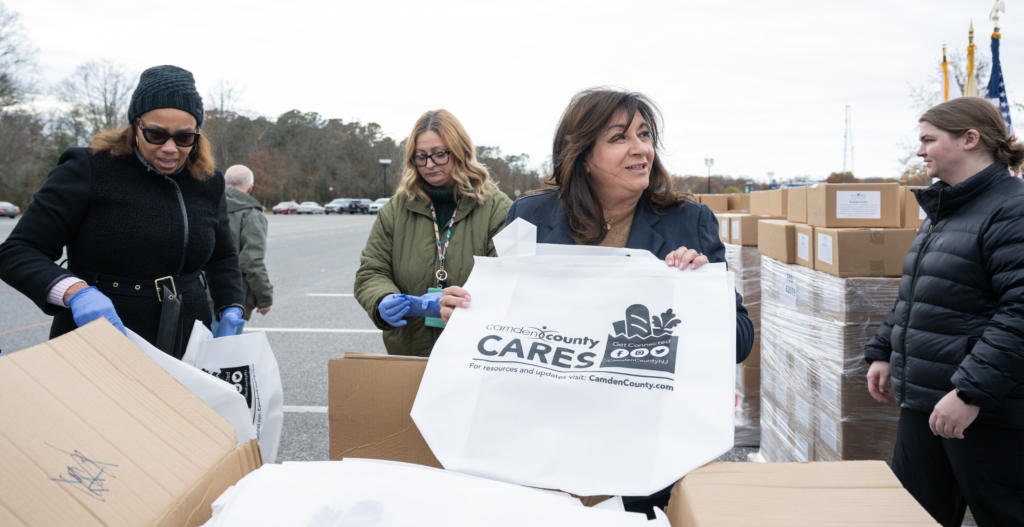
Courtesy of Camden County Board of Commissioners Camden County Commissioner Virginia Betteridge unloads bags for produce while helping distribute food to constituents.
Across the nation, the Nov. 1 cuts to SNAP benefits resulting from the shutdown of the federal government have increased the need for food pantries to provide for those experiencing food insecurity.
Camden County is no different, with the board of commissioners holding an emergency food distribution event at Camden County Community College on Nov. 12, assisting SNAP recipients, as well as federal workers who had to either stop working, or if considered essential, work for over a month without a paycheck.
Approximately 75,000 county residents receive SNAP to help them afford food, with about half of all recipients being children and another third having a disability.
Though the government reopened on Nov. 12, the impact of the delayed pay and SNAP benefits was still felt by many.
“The billions in SNAP that was held up can’t be replaced by the few million we’ve put in it,” said New Jersey Secretary of Agriculture Ed Wengryn.
“… People should continue to donate to our food banks, our pantries, our soup kitchens, and everybody who helps feed the hungry, because it is an unending need, particularly in these times of higher cost for everyone.”
In order to receive the emergency food donations, participants were required to provide proof of residence in Camden County and show either their SNAP benefits card or their federal employee ID.
Food was provided by the Food Bank of South Jersey and Farmers Against Hunger, with all recipients receiving a bag of produce and a care box of nonperishable food and ingredients that would be able to create a full meal, including rice, canned vegetables, pasta, peanut butter, cereal and applesauce.
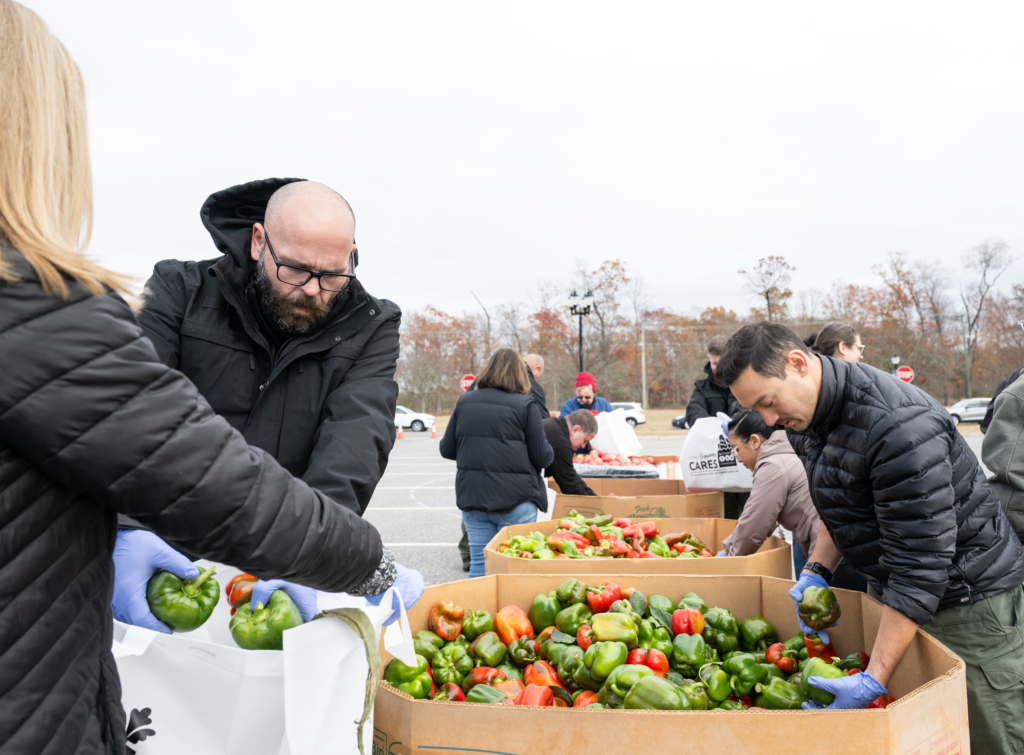
Apples, oranges, peppers and sweet corn were provided to families, with all of the produce except the oranges being locally grown in South Jersey.
Courtesy of Camden County Board of Commissioners
Volunteers load apples into bags to be given out to SNAP recipients and government employees.
Linda Palmquist was one of the Food Bank of South Jersey volunteers present for packaging and handing out the donations.
“Volunteering today was very easy,” Palmquist noted. “It was very organized…
“It’s ridiculous that we should have hungry people in this country, ever.”
Volunteers gathered from 1 to 3 p.m. to begin packaging the produce into fabric bags and piling the bags onto pallets next to the pallets of care boxes, allowing for an organized distribution of the supplies.
Camden County Community College dietary technician student Whitney Robinson was another volunteer, who felt compelled to help during her free time.
“No one should be going hungry in our country, especially since we have a surplus,” she said. “… There’s a big disparity between children and the elderly. Everyone, in general, just needs to have nutritious food.”
The event was conducted in a drive-thru only format, with recipients being required to be in a car to receive the food on a first-come, first served basis.
Public officials from the county, state and local levels, as well as leaders from the Food Bank of South Jersey and the New Jersey Agricultural Society were all in attendance, joining food bank volunteers in handing out the donations.
Officials also emphasised that with most New Jersey schools being closed the first week of November, food insecure students were even more vulnerable, and they commended the efforts of local school districts in combating hunger.
“They cared enough to bring their staff in and to make sure that no student was hungry last week,” said Camden County commissioner Virginia Betteridge.
As families drove up in two lines on either side of the pallets of food, volunteers and officials opened the trunk or backseat of each vehicle.
Distribution of the supplies began at 3 p.m. and lasted until 5 p.m., with all of the supplies going to those in need throughout the county.
For the next month, South Jersey residents will be overwhelmed by television and social media ads – as well as mailed flyers – urging them to vote for either Democrat Mikie Sherrill or Republican Jack Ciattarelli as the next governor of New Jersey in the general election on Nov. 4.
Sherrill, who served in the U.S. Navy, has been a member of Congress since 2018. She was a private practice lawyer who also worked for the U.S. Attorney’s office in the District of New Jersey.
Ciattarelli lost a close race to Gov. Phil Murphy in the 2021 gubernatorial election, and was a member of the state assembly from 2011 to 2018, serving as the assistant minority whip five of those years.
The gubernatorial race is a dead heat, according to a recent poll by Emerson College. It shows that each candidate got support from 43% of likely voters, who will also elect candidates to serve in the assembly and on the Burlington, Camden and Gloucester County Board of Commissioners.
STATE ASSEMBLY
THIRD DISTRICT
Democrats Heather Simmons and Dave Bailey Jr. are running against Republicans Chris Konawell and Lawrence Moore for two seats.
FOURTH DISTRICT
Democrats Dan Hutchinson and Cody D. Miller are running against Republicans Amanda Esposito and Gerard “Jerry” McManus for two seats.
FIFTH DISTRICT
Democrats William F. Moen Jr. and William W. Spearman are running against Republicans Constance Ditzel and Nilsa Gonzalez for two seats.
SIXTH DISTRICT
Democrats Louis D. Greenwald and Melinda Kane are running against Republicans John M. Brangan and Peter Sykes for two seats.
SEVENTH DISTRICT
Democratic candidates incumbent Carol Murphy and newcomer Balvir Singh are running against Republican candidates Douglas Dillon and Dione Johnson for two seats in the NJ Assembly.
CAMDEN COUNTY COMMISSIONERS
Democrats Edward T. McDonnell and Colleen Bianco Bezich are running against Republicans Christian A. Navarro and Robert Stone for two seats.
Democrat Jennifer Fleisher is running against Republican Shane Bernat for one unexpired seat.
CAMDEN COUNTY SURROGATE
Democrat Michelle Gentek-Mayer is running against Adam Nieves.
GLOUCESTER COUNTY COMMISSIONERS
Democrats Frank DiMarco and Denice DiCarlo are running against Republicans Jonathan Sammons and Bryon Driscoll for two seats.
BURLINGTON COUNTY COMMISSIONERS
Democrat Allison Eckel is running against Republican Joe Abegg for a full term, and Democrat Randy Brolo is running against Republican Nick Pawlyzyn for an unexpired term.
BURLINGTON COUNTY SHERIFF
Democrat James Kostoplis is running against Republican Erik Johnston.
There are about 1.8 million people in the U.S. in correctional facilities, including state and federal prisons, local jails, juvenile detention centers and immigration detention facilities, according to the Prison Policy Initiative.
That’s why Freedom Reads has made it a mission to put hand-crafted bookcases called Freedom Libraries into the hands of inmates across the country. The national organization installed the first of its county-level facilities at the Camden County Juvenile Detention Center on Sept. 15.
Tyler Sperrazza is the chief production officer for Freedom Reads.
“Our entire mission is about bringing dignity to those who are incarcerated,” he explained, “and reminding them that the walls between the inside and the outside can be more porous, and books are the way to do that right.”
The county detention center got one Freedom Library for its female housing unit and another for the male unit. The facility currently houses four female and 28 male residents between the ages of 13 and 21.
Elizabeth Cheer is the site education supervisor for the center. She first approached the Freedom Reads team at a conference of individuals who work on prison re-entry.
“This is the proudest moment of my career, bringing these libraries,” she said.
Reginald Dwayne Betts, founder and CEO of Freedom Reads, was passed a copy of “The Black Poets” while incarcerated as a teen. The experience inspired him to move forward with his life by writing his own poetry. Betts got published before his release from prison and later became a lawyer.
Betts was then inspired to create Freedom Reads, with the goal of putting a Freedom Library in every correctional facility housing unit in the nation. So far, the organization has created 515 libraries in 51 adult and youth prisons, and stocked them with more than 278,500 books.
Several members of the Freedom Reads team, many former prisoners themselves, were on hand for the Camden County presentation. Library coordination manager David Perez DeHoyos explained the emotional impact that being incarcerated can have on an individual.
“It’s disorienting,” he noted. “It’s kind of, in a way, traumatizing, like the shell shock of being out, free in the community, then suddenly behind bars. So there’s … an isolation to it.”
Some of those present for the county unveiling designed and built the detention center bookcases, which are carefully created to be welcoming while allowing for conversation and book sharing.
“Imagine some of the stuff that these kids have been through, and then all of a sudden, they can read a book, and they can be in a different place, in a mindset …,” County Commissioner Jonathan Young observed. “We’re just hoping that this is something that may be a calming agent for them.
“This is something that maybe really starts to turn their life around.”
That the books are new paperback copies is an important aspect of Freedom Reads.
“We want to make sure that we’re showing folks on the inside that they are valued in a way, that they deserve new books, and they deserve to be the first person that’s opened that book and read that book,” Sperrazza pointed out. “We … want them to be able to have that experience.”
The library bookcases are filled with titles carefully selected to best serve the needs of the center’s juvenile residents. They include young adult books of several different genres: science fiction, poetry, non-fiction and literary classics.
The Freedom Library unveiled at the Camden County Juvenile Detention Center on Sept. 13 has a curated selection of books and genres.
“I really just want them to have their horizons open and to learn about things that maybe they didn’t even know existed before hand,” Cheer emphasized, “and just also to understand that people care about them enough to have brought these books, these libraries and this knowledge to them.”
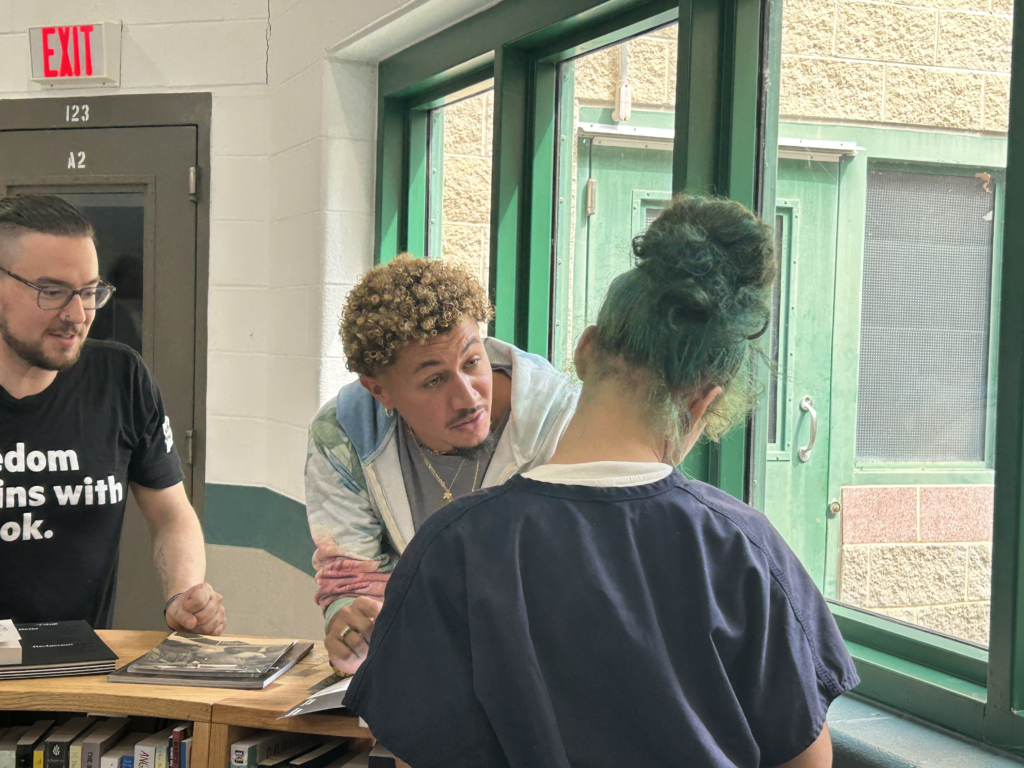
One of the female juveniles at the center – identified only as JB – was offered recommendations from a member of Freedom Rides based on books she enjoyed.
David Perez DeHoyos of Freedom Reads and a detention center juvenile indentified at JB discuss books at the new Freedom Library.
During an an assembly-style presentation for inmates at the center, each of the formerly incarcerated members of the Freedom Reads team stepped up to the podium to share how books changed their lives.
Kevin Baker, another library production manager for the organization, shared a story about one library that was met with hostility and aggression by inmates – until the books appeared.
“I watched grown men go from violence to compassion and gratitude in 21 minutes,” he recalled, “because of these books.”
Albert J. Countryman Jr./The Sun Professional wine connoisseurs Daniele Raspini (left to right), Michelle Padberg, New Jersey Secretary of Agriculture Ed Wengryn and Edward Miller at the Terroir New Jersey Wine Showcase on July 19.
Winemakers William Alexander and Edward Antill won Great Britain’s Royal Society award of 200 pounds in 1758 for producing a quality wine similar to those England had been purchasing from France, marking the beginning of the New Jersey wine industry.
Master vintner Louis Nicholas Renault of France bought land in Egg Harbor City in 1864, and by 1870, had introduced New Jersey champagne. His Renault Winery later won prizes for excellence and became the largest distributor of champagne in the U.S.
“The Renault Winery is the oldest in the country,” said Scott Doninni, owner of the Auburn Road Winery in Pilesgrove, who participated in the Terroir New Jersey Wine Showcase on July 19 at the Camden County Sustainability Center in Blackwood.
“New Jersey had a very significant wine culture and industry before being devastated by Prohibition,” noted Doninni, who received valuable tips and information about growing wine from 12 world-renowned connoisseurs at the wine showcase, sponsored by the Camden County Board of Commissioners.
“This showcase is excellent,” he added. “It’s good for all the wineries in New Jersey.”
Doninni and his wife, Julianne, grow eight varieties of grapes and produce 16 wines on 23 acres of land they purchased in 2001 after retiring as lawyers in Philadelphia. They were thrilled to learn more from national and international wine experts at the showcase.
“This is a benchmark moment for all of us,” Doninni explained, adding that the wine connoisseurs were very serious and professional about “assessing our progress.”
New Jersey Secretary of Agriculture Ed Wengryn said he was happy to be part of the showcase and is pleased with the growth of the state’s wine industry.
“This shows that using only New Jersey grapes we can produce quality wines,” he related.
After Prohibition, New Jersey provided only one winery license for each million residents, and they were practically impossible to obtain. By 1981, the state had just seven wineries – and everything changed. That year, the state approved the Farm Winery Act, the first of several efforts by the legislature to relax Prohibition-era restrictions and craft new laws to facilitate the alcoholic beverage industry’s growth and provide new opportunities for winery licenses.
The industry has boomed since then. By 2014, there were 48 licensed and operating wineries in the state; as of this year, there are 73.
“The goal of the showcase is to set benchmarks of quality for the state,” offered Sharyn Kervyn de Volkaersbeke, owner of KdV Wine Services in Voorhees. Terroir New Jersey appointed her to manage the event “based on her extensive expertise, reputation and credentials, which are well aligned with our mission, thereby ensuring that the goals will be met and surpassed.”
“The mission of the Showcase is to acknowledge and celebrate excellence in winemaking among wins produced in New Jersey,” Volkaersbeke pointed out. “It aims to establish and solidify New Jersey’s reputation as a premier destination for quality wine.”
Winery owners at the showcase sat at long tables in the meeting room across from the connoisseurs, who were divided into four groups of three. They tasted the wines and rated them for clarity, purity, intensity, complexity, aroma, length, harmony and overall quality.
“I’m a New Jersey wine virgin,” said Master of Wine Martin Moran, who has lived in Dublin, Ireland, for the past 30 years and has traveled the world helping winemakers improve their products. “This is my first time here. Some of the classic wines here are really good. The varieties unique to New Jersey are getting better.
:This state has a great future in winemaking.”
Moran studies the production of wine from “the grape to the glass,” including the soil and what types of grapes work best. During the showcase, experts independently assessed each wine in a blind format base and identified key quality indicators.
Wines that achieved a predetermined minimum evaluation rating will be designated as Showcase Selection wines and will be widely promoted at upcoming events, said Camden County Commissioner Al Dyer.
“New Jersey, and Camden County specifically, is becoming a world-class wine destination, boasting bountiful vineyards and successful wineries,” Dyer emphasized. “We are thrilled to welcome this group of wine experts to the sustainability campus, home to our very own Camden County Vineyard, to test the very best wines that New Jersey has to offer.”
“We are honored to hold the Terroir Showcase at our state-of-the-art Sustainability Center, which is where our Lakeland Vineyard is located,” said Commissioner Jonathan Young, liaison to the Office of Sustainability. “Our vineyard has produced bountiful harvests season after season, and this past fall, a fourth crop of chambourcin grapes from the vineyard was produced and delivered to Saddlehill Winery in Voorhees.
“Camden County is quickly becoming a world class wine destination, so we couldn’t think of a better location to host such a prestigious event.”
Albert J. Countryman Jr./The Sun Breaking ground to launch renovations to the historic Benjamin Cooper Tavern on July 7 were Camden Councilwoman Jannette Ramos (left to right), Assemblyman Bill Moen, Congressman Donald Norcross, Camden Mayor Vic Carstarphen, council President Angel Fuentes and Councilwoman Nohemi Soria-Perez.
On a lonely stretch of overgrown ground just north of the Ben Franklin Bridge stands a building built in 1734 that played a major part in the Revolutionary War.
Built by the grandson of Camden’s founder, William Cooper, the Benjamin Cooper Tavern offered food and beverages to people crossing the Delaware River from Philadelphia on the Cooper’s Point Ferry. It continued to serve as an inn, tavern and ferry headquarters, and was the center of many battles in South Jersey during the English army’s Philadelphia Campaign of 1777 and 1778.
“Welcome to North Camden,” the city’s mayor, Vic Carstarphen, said during July 7 groundbreaking ceremonies for a $4-million restoration project to the historic building at 75 Erie Street. “Today we are reclaiming Camden’s story.”
The objective is to transform the building into the American Revolution Museum of Southern New Jersey ahead of America’s 250th birthday next July.
“The Coopers have a long history in Camden,” the mayor noted, “and the city has played a huge role in maritime history. It is great timing to begin this work with the 250th anniversary approaching.”
“This is a great day,” added Councilwoman Jannette Ramos. “We are reclaiming a piece of Camden’s soul. This is a new chapter of preserving and protecting our history.”
“It is so good to be here,” said Congressman Donald Norcross, who helped get a $500,000 grant from the Community Development Fund for the project. “This piece of land is so important. This tavern is about the story of our country.”
“I coached for four years with the North Camden Little League, and passed this building hundreds of times,” relayed state Assemblyman Bill Moen, who was able to obtain a $650,000 state grant to help restore the tavern. “Thanks to the Camden County Historical Society for giving us guidance.”
“We are honored and very excited (about the restoration),” said Jennifer Fleisher, a member of the Camden County Board of Commissioners that awarded a $350,000 grant to help fund the project.
“The Benjamin Cooper Tavern is one of Camden City’s most significant historic sites, so it is imperative that we preserve it for generations to come,” Commissioner Jeffrey Nash said. “This project will keep an important piece of regional history alive and will allow residents and visitors to learn more about the history that surrounds them on a daily basis. We are thrilled to see this project move forward and cannot wait to visit the museum once it is completed.”
“This is the most historic surviving building in Camden,” noted Chris Perks, president of the Camden County Historical Society’s board of directors, who secured a 30-year lease for the property and got a $1.4-million grant from the New Jersey Historic Trust.
Society Executive Director Jack O’Byrne said the organization learned that someone had purchased the 17-acre industrial site the tavern was on and “we were concerned that they may have plans to demolish it. The owner was supportive of our plan to raise money to restore it and create the new museum.”
The building was in terrible shape and there was a 2012 fire that tore through the roof. The temporary roof was put on two years later, so the interior was exposed to the elements all that time, according to O’Byrne.
“It’s amazing that the floors did not collapse and the walls didn’t cave it,” he marveled, adding that the original 1734 building is all there, as well as the 1830 expansion and the 1917 wing. “In February 2024, we started the stabilization of the interior and restoration of the exterior.”
The skirmish at Cooper’s Ferry happened in March of 1778 and the Hessians came and went through there for the Battle of Red Bank. Some 15,000 troops went through during the evacuation of Philadelphia on the way to the skirmish in Haddonfield and the Battle of Monmouth. The New Jersey Militia attacked the British encampment there, and 32 were taken prisoner or killed at the site.
Plans for the museum include displays about the many Revolutionary War battles and skirmishes in South Jersey during the Philadelphia Campaign.
“We’ll finish the exterior masonry and the first-floor interior and open before July 4, 2026,” O’Byrne projected. “When we first did our preservation plan in 2021, the estimate to complete the project was $2.9 million.
“Because of construction increases, inflation, tariffs, etc., the final cost will be closer to $5 million, and we still need to raise $1.5 million more to finish. If we raise the additional funds, we can finish the project by the 250th anniversary of the British occupation of Philadelphia in September 2027, which is the start of our local American Revolution history.”
In the early 19th century, the Benjamin Cooper House served as a pleasure garden and was open to the public in spring and summer. It was the last ferry tavern in Camden and a saloon in its later years that was known as the Old Stone Jug.
In the 21st century, it will become a museum, thanks to a group effort by the Camden County Historical Society and local, county, state and federal agencies, and it will continue its life teaching future generations about U.S. history.
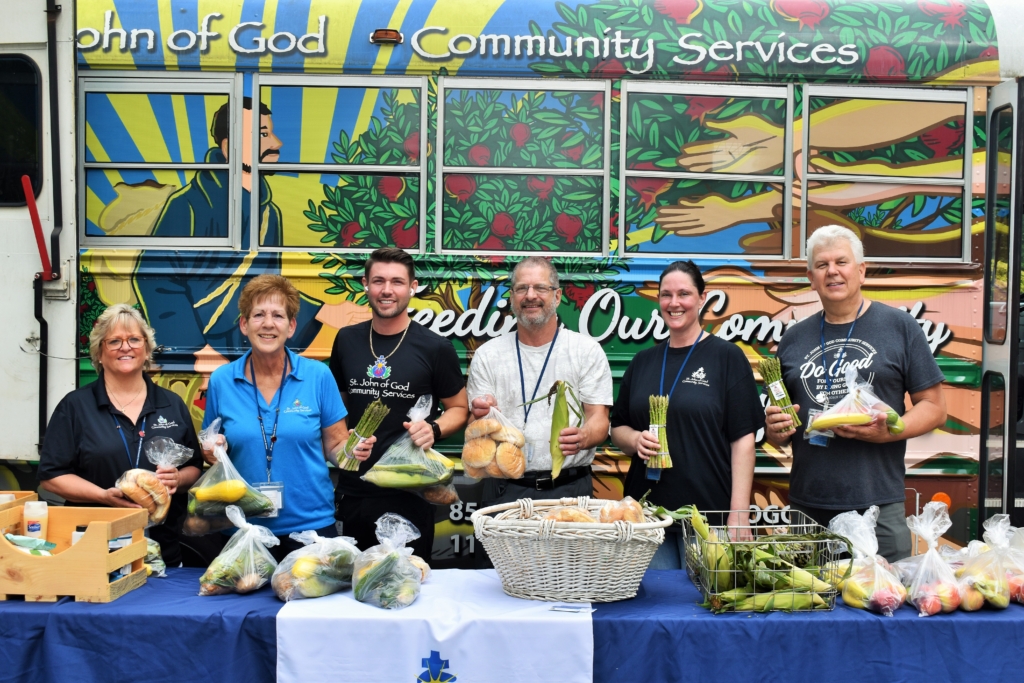
Albert J. Countryman Jr./The Sun St. John of God staff members in front of its mobile food pantry prepare to distribute fresh produce to seniors. Shown are Karen Sapio (left to right), Linda Bradford, Michael Myers, Douglas Agren, Jen Hope and Jeff Sanders.
Senior citizens born between 1925 and 1960 have lived through turbulent times, seen incredible advances in technology, watched men land on the moon, and worked hard most of their lives.
Those approaching 100 were children of the Depression. As they became young men, many fought in World War II and the Korean War, watching friends die on the battlefield and returning home scarred by the ravages of combat. Their wives contributed to the war effort by working in factories and buying groceries with ration stamps.
Their children are Baby Boomers, born during the Cold War, hiding under desks in case of nuclear war and losing their innocence forever with the assassinations of John F. Kennedy, Robert Kennedy and Martin Luther King Jr. Those drafted had to fight in Vietnam, while some chose to protest at home.
Then eventually faced reality, got jobs, raised families and watched technology explode from land lines with party lines to mobile phones that are powerful computers. Through it all they paid taxes, assured there would have enough money from Social Security to retire comfortably.
Not always true – especially with the high cost of living.
“Many seniors are coping with the loss of a spouse, which can be both emotionally and financial challenging,” said Arlene Kreider, executive director of Senior Citizens United Community Services Inc. (SCUCS) of Camden County in Audubon. “They are often combating feelings of loneliness mixed with the realization that they now have to adjust to a single income.
“The rising costs of food, medications and out-of-pocket medical care only enhance the problem,” she added. The SCUCS mission is “to enhance the quality of life and encourage independence of senior citizens.”
Its programs for seniors include Respite Care (offering relief to caregivers), a short term Personal Care Program (assistance with bathing, dressing, meal prep, laundry, etc.), Housing Counseling, Benefits Counseling, SHIP (State Health Insurance Assistance Program) Counseling, a Food Pantry, a Lending Closet (medical supplies such as walkers, rollators, wheelchairs etc), Sen Han Transportation and the Trips/Recreational Tours and Travel program whereby seniors take day trips and week-long vacations for a reasonable price.
“Our trips offer an opportunity for seniors to explore new places in a relaxed manner, knowing that all the arrangements have already been taken care of,” Kreider explained. “Friends and couples can travel together and it offers an opportunity for new friendships to be formed.”
Some residents of the Gloucester Towne senior complex in Gloucester City struggle to buy more non-processed foods and fresh fruit and vegetables, especially if they have to walk to the grocery store. But they got a break on June 18, when the St. John of God mobile food pantry arrived at the complex.
Staff members Karen Sapio, Linda Bradford, Michael Myers, Douglas Agren, Jen Hope and Jeff Sanders greeted the seniors with plenty of fresh produce.
“A lot of people can’t get out and purchase their food,” noted Sapio, the pastoral care coordinator, adding that the donations were provided by Murphy’s Farm Market in Swedesboro, Grasso Girls in Mullica Hill and Pikser’s Bakery in Westville. They included potatoes, squash, corn on the cob and fresh rolls.
“We also give out personal-care items,” she added, “like toothpaste, shampoo and adult diapers.”
“It’s hard for some of the seniors to get to the store,” added Hope, an accountant with St. John of God whose mother, Nancy, lives in Gloucester Towne. “This is an opportunity for them to get fresh, healthy produce.”
There are many programs in Camden County that assist senior citizens. For information about the mobile pantry, go to www.sjofcs.org. For information about SCUCS programs go to www.scucs.org.
For information about services provided by the county board of commissioners, visit www.camdencounty.com and click on senior-disabled services.
Gubernatorial hopefuls Mikie Sherill, a Democrat, and Jack Ciatterelli, a Republican, will face each other in the Nov. 4 general election.
Sherill defeated Sean Spiller, Steve Sweeney, Steven Fulop, Ras J. Baraka and Josh Gottheimer in the Democatic primary election on June 10, while Ciattarelli defeated Justin Barbera, Bill Spadea, Mario M. Kranjac and Jon Bramnick.
STATE ASSEMBLY
Running unopposed in the primary election for two seats in the assembly’s District 5 representing Camden and Gloucester counties were Democrats William F. Moen Jr. and William W. Spearman. They will face Republicans Constance Lee Ditzel and Nilsa Gonzalez in the general election.
In the 7th District representing towns in Burlington County, candidates in the primary ran for two assembly seats. Democratic incumbents Carol Murphy and Balvir Singh beat candidate Eric Holliday and will face Republicans Dione Johnson and Doug Dillon, who ran unopposed.
CAMDEN COUNTY COMMISSIONERS
After running unopposed in the primary for two seats on the Camden County Board of Commissioners, Democrats Edward T. McDonnell and Colleen Bianco Bezich will face Republicans Christian A. Navarro and Robert Stone in November. Democrat Jennifer Fleisher will face Republican Shane Bernat for one unexpired seat.
COUNTY SURROGATE
Democrat Michelle Gentek-Mayer will run against Republican Adam Nieves in November to become the county surrogate. Republican Adam Nieves is running unopposed.
GLOUCESTER COUNTY COMMISSIONERS
Democrats Frank DiMarco and Denice DiCarlo ran unopposed in the primary and will face Republicans Jonathan Sammons and Bryon Driscoll in the general election for two seats on the Gloucester County Board of Commissioners.
BURLINGTON COUNTY COMMISSIONERS
Democrat Allison Eckel will run for a full term on the Burlington County Commissioners against Republican Joe Abegg in November. Democrat Randy Brolo will face Nick Pawlyzyn for an unexpired term.
BURLINGTON COUNTY SHERIFF
Democrat James Kostoplis will face Republican Erik Johnston in the race for Burlington County sheriff.
Albert J. Countryman Jr./The Sun Taking a break at Joseph’s House of Camden on May 20 were Executive Director Colandra Coleman (fourth from right) and her staff. Paintings by Brother Mickey McGrath, an oblate of St. Francis De Sales, were in the background.
“When you’re down and out,
When you’re on the street,
When evening falls so hard,
I will comfort you.”
“Bridge Over Troubled Water,” Simon & Garfunkel
Rough living on the streets is a constant struggle for people – many of whom have been forgotten by family, friends and society.
But like a lighthouse signaling a safer path for ships, there is a beacon of hope at 555 Atlantic Ave. St. Joseph’s House of Camden (JHOC) is a homeless shelter guided by the principles that everyone can change their situation in life and every guest has dignity and deserves respect.
In an effort to improve services and hear success stories from guests who’ve found a safer path, the shelter has transitioned to a 24/7 operation. Executive Director Colandra Coleman said in an interview on May 20 that JHOC had previously been open daily from 7 a.m. to 2 p.m. and again from 8 p.m. to 7 a.m.
“Before, from 2 to 8 p.m., people left to brave the elements and return to dysfunctional behavior,” explained Coleman, who earned her bachelor’s in sociology at George Washington University in Washington, D.C. “These are the people where stability is critical. We can now offer that stability by creating round-the-clock services.
“I would walk to the reflection pond and was shocked by the number of homeless and veterans encamped there,” she added. “I needed to do something.”
Coleman was the director of Ready, Willing and Able in Philadelphia – a transitional housing agency – for five years before joining JHOC two years ago. The new hours are a lifeline for 80 to as many as 100 guests during Code Blue freezing temperatures and they fulfill a long-standing goal to provide continuous, reliable support to individuals experiencing homelessness, not just a place to sleep, but ongoing access to shelter services and hope.
JHOC has addiction and financial literacy programs, AA and Narcotics Anonymous meetings and social services that enable guests to get help from government organizations such as the VA.
“We are non-secular,” Coleman emphasized. “We take folks that others won’t, the most vulnerable active in their addiction. Sometimes they come in high. Our guests need stability, and by staying open 24/7, we can be there for them every hour of every day,.”
JHOC addresses problems like addiction before placing guests in housing or employment. Three staff members are from Maryville Addiction Services and a doctor from that facility comes to JHOC once a week, according to Coleman.
To accommodate the round-the-clock operations, she and JHOC leadership implemented several changes to the schedule, staffing and human-resource protocols, including hiring eight full- and part-time employees, moving from a two-shift, day-and-night structure to a three-shift structure, and introducing new meal times better suited to a 24/7 operation.
“Our staff shows up every day,” Coleman stated, addig that employees and guests have mutual dignity and respect for each other. “Without them, we don’t operate. It’s because of the staff that we have so many success stories, which keeps the staff motivated.”
Future plans include a mobile outreach program that can get directly to people on the streets or in encampments.
The origin of St. Joseph’s House dates back to 2010, when the late Msgr. Robert McDermott was pastor of St. Joseph’s Pro-Cathedral Church in downtown Camden. Known affectionately as “Father Bob,” he had to step over people sleeping on the porch of his office. He set up a small café in the rectory to feed them, and it evolved into a larger café at a Stevens Street building.
With the help of TD Bank, the JBJ Soul and Connelly foundations, the Camden mayor and council and the Camden County Commissioners, JHOC bought a building at 555 Atlantic Ave. in August of 2013 and undertook a five-month renovation. It reopened in January of 2014.
For two months, South Jersey residents have been overwhelmed by television and social media advertisements – as well as flyers – from the 11 candidates who hope to be New Jersey’s next governor.
They can expect more. Six Democrats and five Republicans will battle it out for their respective nominations in the primary election on Tuesday, June 10. The winners will run in the general election on Tuesday, Nov. 4.
The Democrats are Sean Spiller, Steve Sweeney, Mikie Sherrill, Steven Fulop, Ras J. Baraka and Josh Gottheimer. The Republicans are Jack Ciattarelli, Justin Barbera, Bill Spadea, Mario M. Kranjac and Jon Bramnick.
Democratic candidates
Sean Spiller has been president of the New Jersey Education Association since 2021. Before that, he was a teacher who served as both mayor of Montclair and a member of its council.
Steve Sweeney is a former ironworker who was state senate president and represented the 3rd District for 20 years. Sweeney was also a member of the Gloucester County Board of Commissioners.
Navy veteran Mikie Sherril has been a member of Congress representing New Jersey since 2019. She was also a private practice lawyer who also worked for the U.S. Attorney’s Office.
Steven Fulop, a Marine, has been the mayor of Jersey City since 2013. Before that, he was a member Jersey City council and worked in finance.
Ras J. Baraka has been the mayor of Newark since 2014, before which he was a member of its council. He was both a high-school teacher and a principal.
Josh Gottheimer has been a member of Congress representing the state since 2016. He worked for Microsoft as a strategist and was a speechwriter for former President Bill Clinton.
Republican candidates
Jack Ciattarelli lost the gubernatorial primary in 2017 and the general election to Gov. Phil Murphy in 2021, and was a member of the state assembly from 2011 to 2018. He was the assistant minority whip for five of those years.
Justin Barbera grew up in Marlton and graduated from Holy Cross High School in Delran. He has worked as a real estate developer and general contractor, and supports charities such as Habitat for Humanity.
Bill Spadea, a Marine, has been the host of radio’s “Bill Spadea Show” and “Chasing News.” He ran for a Congressional seat in in 2004 and for state assembly in 2012.
Mario M. Cranjak was mayor of Englewood Cliffs for two terms, and is an attorney and venture capitalist in life sciences.
Jon Bramnick is a state senator who has represented District 21 since 2022, and has been a member of and minority leader in the assembly for 19 years.
State assembly candidates
In the 5th District representing towns in Camden and Gloucester counties, the candidates running unopposed in the June 10 primary election are vying for two seats in the state assembly. They are Democrats William F. Moen Jr. and William W. Spearman and Republicans Constance Lee Ditzel and Nilsa Gonzalez, who are also unopposed.
In the 7th District representing towns in Burlington County, candidates running in the June 10 primary election are vying for two seats in the state assembly. There are three Democratic candidates, incumbent Carol Murphy and incumbent Balvir Singh, who are running on the party line, and Eric Holliday, who is running for Democrats for Change. Republican candidates, Dione Johnson and Doug Dillon, are running unopposed.
Camden County commissioners
Running unopposed for two seats are Democrats Edward T. McDonnell and Colleen Bianco Bezich. Jennifer Fleisher is running unopposed for one unexpired seat. Republicans Christian A. Navarro and Robert Stone are running unopposed for two full terms, and Shane Bernat is running unopposed for the unexpired seat.
Camden County surrogate
Democrat Michelle Gentek-Mayer is running unopposed, as is Republican Adam Nieves.
Gloucester County commissioners
Democrats Frank DiMarco and Denice DiCarlo are running unopposed for two seats. Republicans Jonathan Sammons and Bryon Driscoll are also unopposed.
Burlington County commissioners
Democrat Allison Eckel is running unopposed for a full term, and Randy Brolo is running unopposed for an unexpired term. Republican Joe Abegg is running unopposed for the full term, and Nick Pawlyzyn is running unopposed for the unexpired term.
Burlington County sheriff
Democrat James Kostoplis is running unopposed, as is Republican Erik Johnston.