Author: atwiford

  • The history behind Washington’s Delaware crossing

    Abigail Twiford/ The Sun
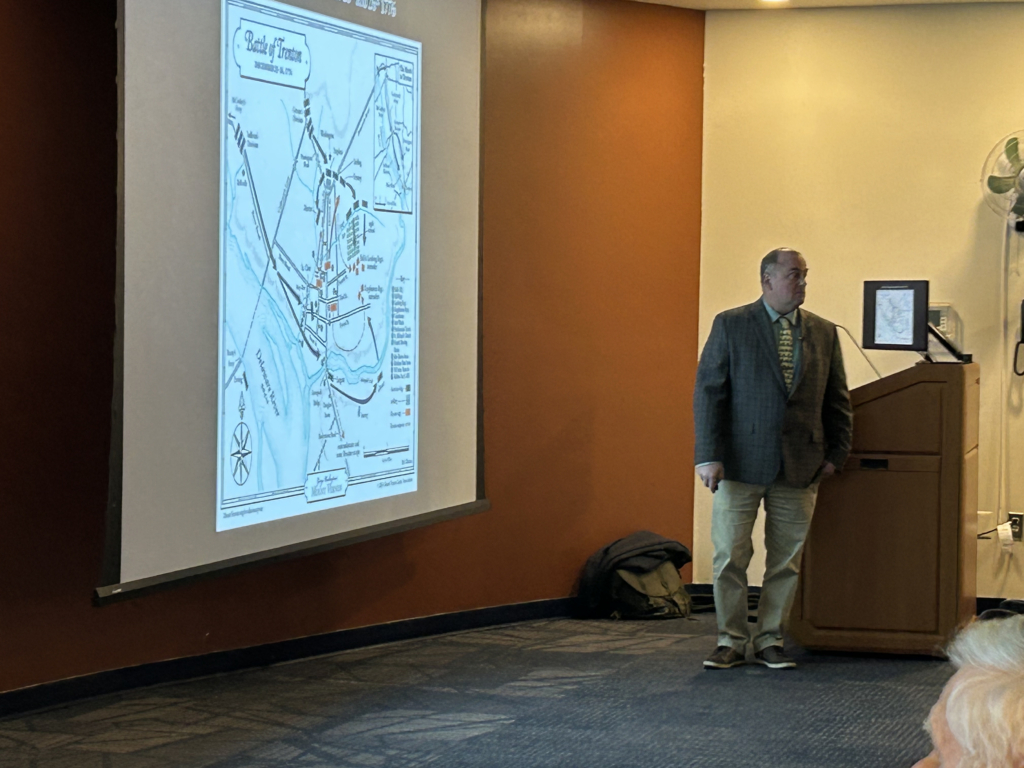
    Michael Jesberger displays a map illustrating the Battle of Trenton during his presentation on Washington’s Crossing.

    As part of its grant-funded series to commemorate America’s 250th anniversary continues, the township library held a Dec. 3 lecture on Washington’s 1776 crossing of the Delaware River and the subsequent battles of Trenton.

    The discussion was led by Michael Jesberger, an independent military historian specializing in the Revolutionary and Civil War periods.

    “You know, 250 years is not a lot compared to the rest of the world,” he remarked, “but it’s ours, our 250th So yes, we made it. We should be very pleased and very happy that we made it that far.” 

    Jesberger started off the discussion with a slide showing the most famous representation of the crossing, the Emanuel Leutze painting titled “Washington Crossing the Delaware.” But he also highlighted its inaccuracies.

    “You have George Washington standing upright,” he explained. “Not a good move on a little boat like that with his leg first on the side of the boat. That’s probably not good either. Not good to be mixed in on such a small boat with the rank and file.”

    But Jesberger acknowledged that the painting is an artistic representation of Americana rather than historical fact.

    As he transitioned out of that and into the story of the crossing, Jesberger stressed that the crossing of the Delaware was a major turning point for the Continental Army during the war, with the summer and fall of 1776 seeing several massive losses among American troops.

    “In the summer and fall of 1776, it’s an absolute disaster and total collapse,” he pointed out. “It’s incredible. In the summer of that same year, Washington takes command of an army, a rebel army, of 20,000 men, maybe the highest the army will be at.” 

    Jesberger explained that while those numbers seem low compared with the country’s modern armies and wars, it’s what Washington had to work with at the time. The British had control of New York, so Washington knew he had to make some kind of move to keep the revolutionary effort going. He formulated the plan for three crossings of the Delaware that would allow for a sneak attack on Hessian forces. 

    Due to a variety of setbacks and struggles, Jesberger emphasized, the group Washington led was the only one to actually make it across the river, though it faced challenges that delayed the attack, reaching the Hessians only during the day instead of taking them by surprise at night.

    Jesberger also highlighted various local landmarks in South Jersey and the Philadelphia area that relate to the battle and the crossing.

    “It’s an unbelievable part of your heritage and history here in New Jersey,” Jesberger observed, “and that’s where the Hessians would be.”

    Jesberger also explained that at the site of Washington’s Crossing, there is a marker of the unknown soldiers who died.

    “As we move into the festive season,” he advised, “we should always remember and reflect on our first veterans, because if we don’t, who will?”
  • The history behind Washington’s Delaware crossing

    Abigail Twiford/ The Sun
    Michael Jesberger displays a map illustrating the Battle of Trenton during his presentation on Washington’s Crossing.

    As part of its grant-funded series to commemorate America’s 250th anniversary continues, the township library held a Dec. 3 lecture on Washington’s 1776 crossing of the Delaware River and the subsequent battles of Trenton.

    The discussion was led by Michael Jesberger, an independent military historian specializing in the Revolutionary and Civil War periods.

    “You know, 250 years is not a lot compared to the rest of the world,” he remarked, “but it’s ours, our 250th So yes, we made it. We should be very pleased and very happy that we made it that far.” 

    Jesberger started off the discussion with a slide showing the most famous representation of the crossing, the Emanuel Leutze painting titled “Washington Crossing the Delaware.” But he also highlighted its inaccuracies.

    “You have George Washington standing upright,” he explained. “Not a good move on a little boat like that with his leg first on the side of the boat. That’s probably not good either. Not good to be mixed in on such a small boat with the rank and file.”

    But Jesberger acknowledged that the painting is an artistic representation of Americana rather than historical fact.

    As he transitioned out of that and into the story of the crossing, Jesberger stressed that the crossing of the Delaware was a major turning point for the Continental Army during the war, with the summer and fall of 1776 seeing several massive losses among American troops.

    “In the summer and fall of 1776, it’s an absolute disaster and total collapse,” he pointed out. “It’s incredible. In the summer of that same year, Washington takes command of an army, a rebel army, of 20,000 men, maybe the highest the army will be at.” 

    Jesberger explained that while those numbers seem low compared with the country’s modern armies and wars, it’s what Washington had to work with at the time. The British had control of New York, so Washington knew he had to make some kind of move to keep the revolutionary effort going. He formulated the plan for three crossings of the Delaware that would allow for a sneak attack on Hessian forces. 

    Due to a variety of setbacks and struggles, Jesberger emphasized, the group Washington led was the only one to actually make it across the river, though it faced challenges that delayed the attack, reaching the Hessians only during the day instead of taking them by surprise at night.

    Jesberger also highlighted various local landmarks in South Jersey and the Philadelphia area that relate to the battle and the crossing.

    “It’s an unbelievable part of your heritage and history here in New Jersey,” Jesberger observed, “and that’s where the Hessians would be.”

    Jesberger also explained that at the site of Washington’s Crossing, there is a marker of the unknown soldiers who died.

    “As we move into the festive season,” he advised, “we should always remember and reflect on our first veterans, because if we don’t, who will?”

  • Board of ed hears latest on budget process

    Cherry Hill Board of Education
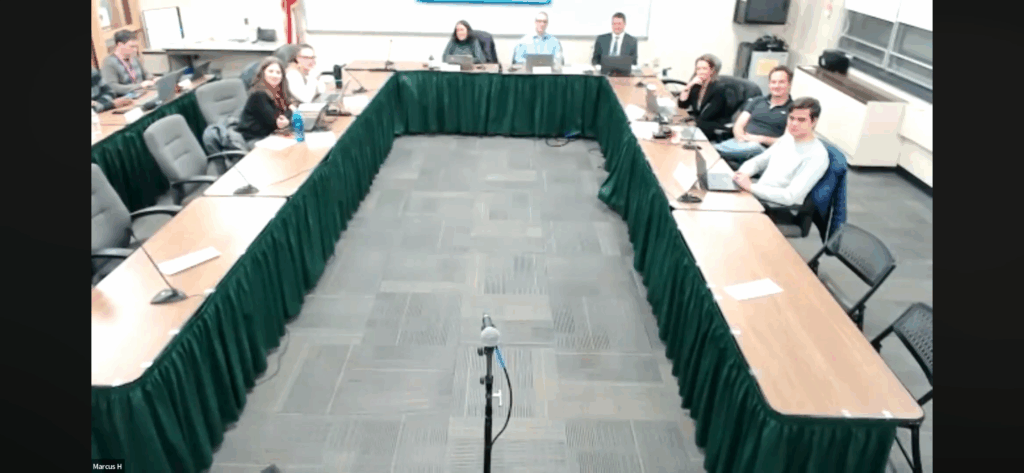
    Board of education members listen to details of the budget for the 2026-’27 school year.

    The township board of education discussed the ongoing process of preparing a 2026-’27 academic year budget at a Dec. 3 meeting.

    Jason Schimpf is the assistant superintendent, business administrator and board secretary responsible for leading the budget preparation process. He presented several slides at the meeting of that process.

    “I’ve continued to make my rounds to each of the schools to meet with their school principals and administrative teams,” he noted. “I really enjoyed those discussions, and I thought, now, consistent with our budget preparation calendar, I would continue to provide some updates at our work sessions as we move through the process here.”

    As schools within the district have until Jan. 16 to justify their budget requests, Schimpf focused primarily on revenue for the meeting. He began with a rundown of the district’s tax levy analysis, which along with the budget fund balance is one of the only pieces of revenue over which the board has control.

    Since there is a 2% cap on the tax levy, that would equate to an additional $4 million in revenue for 2026-’27. The average homeowner in the township would see this impact reflected in a $115 property tax increase. 

    The coming academic year will be the first time since the $300-million bond referendum in 2022 that residents will see a decrease in the principal and interest payments of the bonds. That would continue for the next three fiscal years, translating to a $61 decrease on the debt service side of the budget for the average homeowner.

    “It’ll be a welcome relief having the ability to hopefully or potentially increase the general side of the tax levy to support our operations,” Schimpf pointed out, “while at the same time offsetting that increase with the decrease on the debt service side of things.”

    The district also has about $3.3 million in banked cap – or unused taxing authority – that can be utilized for larger tax increases without a public vote. Unused funds will expire during the next academic year if left unallocated. The tax impact of the banked cap is estimated to be around $97, which would translate to a net increase of $151 in taxes on the average assessed home.

    Schimpf also touched on state aid, though with a new governor taking office in January, that funding is unknown. Some of Gov. Phil Murphy’s budget legislation changes are not permanent, and governor-elect Mikie Sherrill’s plans for those have not been made public.

    One of Murphy’s policies was limiting decreases in state aid to 3% and increases to 6%. 

    “There’s still the potential there, without those caps, that the district could be looking at another substantial state aid cut,” said Schimpf.

    No definitive answer to whether those caps will remain in place will be available to the district until Feb. 26, after Sherrill approves a budget. 

    Schimpf also discussed the district’s fund balance and the different categories in that amount. The unassigned balance functions as the district’s savings account, estimated to be at about $4 million by the end of this school year. Schimpf estimated that in that same time, the fund balance would have about $5 million in designated revenue and $3.8 million in capital reserve, with no restricted funding in the balance.

    The public hearing and final adoption of a budget for 2026-’27 will take place on April 28.